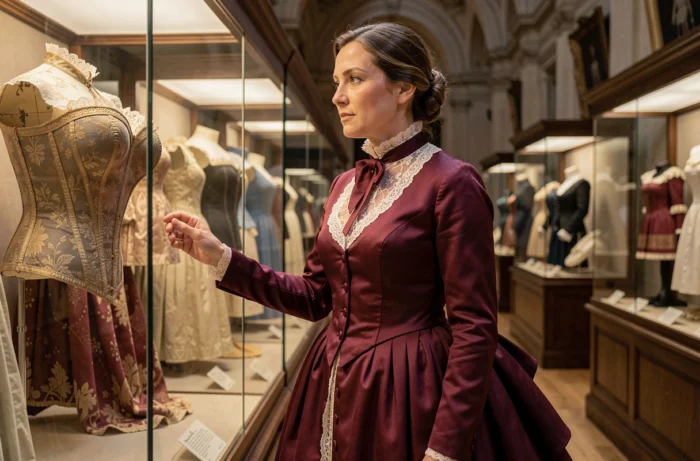
The clothing you wear today tells a story that spans several millennia. Every cut, every fabric, every color is the result of technical choices, climatic constraints, and power dynamics that have accumulated over the centuries. The evolution of fashion is not just a succession of trends: it reflects the profound changes in human societies.
Clothing as a social marker before fashion
Before fashion existed as a phenomenon, clothing served two functions: to protect the body and to signal a position in the hierarchy. The roughly assembled animal skins of prehistory met the survival need against the cold.
Antiquity changed the game. The draped costume, which appeared in ancient Orient, already distinguished the ruling classes from the workers. The fabric, its fineness, and its dye indicated rank. A Roman in a purple toga did not occupy the same place as an artisan in a coarse linen tunic.
This function as a social marker has persisted through the centuries without ever disappearing. In the Middle Ages, sumptuary laws regulated who could wear which fabrics and colors. Fashion as we know it, with its cycles of rapid renewal, did not yet exist.
Transformations followed the slow rhythm of changes in climate, trade, and political power, not that of the seasons. To delve deeper into this topic, the evolution of fashion on Mode in Paris accurately traces these major milestones.

Haute couture and the birth of the fashion system in Paris
The end of the 19th century marks a clear break. Clothing ceases to be made solely by local tailors: the first couturiers create collections renewed each season. Paris then becomes the world capital of couture, a status it still holds.
This shift has concrete consequences. The first fashion show, organized in the 19th century, transforms the presentation of clothing into a spectacle. Bourgeois women no longer just choose a fabric from a tailor: they follow the proposals of a designer whose name becomes a brand.
What haute couture invented
Haute couture did not only produce sumptuous dresses. It established a complete system:
- The seasonal cycle of collections, which imposes a regular renewal of silhouettes and accessories
- The fashion show as a communication tool, where the staging is as important as the clothing itself
- The figure of the designer-artist, whose personal vision dictates fashion trends for an entire clientele
This system has structured the fashion industry for over a century. Paris, Milan, London, and New York still operate on this calendar model with their respective Fashion Weeks.
The 20th century and the democratization of clothing style
The 20th century accelerates everything. The two world wars disrupt wardrobes. During the conflicts, fabric restrictions impose simpler cuts, shorter skirts, and substitute materials. The D system becomes a form of forced creativity.
The post-war period liberates silhouettes. Women adopt clothing that reflects new social freedoms. Jeans, which arrived in France in the late 1960s, symbolize this shift: an American work garment becomes a symbol of rebellion and then a universal basic.
Popular fashion takes power
From the 1960s onwards, fashion no longer descends solely from the couture workshops to the street. The movement reverses. Clothing styles born in the street, in clubs, in protest movements rise back to the designers.
Ready-to-wear explodes. Major brands make accessible trends that were reserved for an elite just a few decades earlier. Fashion becomes a mass phenomenon, driven by advertising, cinema, and then television.

European regulation and sustainable fashion: the turning point of the 21st century
Today, the evolution of fashion is no longer played out solely in design workshops. It is also decided in European institutions. Since July 18, 2024, the European regulation ESPR (Ecodesign for Sustainable Products Regulation, Regulation (EU) 2024/1781) imposes a legal framework on the very design of clothing.
This text provides mandatory requirements for sustainability, reparability, and recyclability for textile products. Specific delegated acts for clothing are expected around 2027. Brands will have to design clothing intended to last, not to be thrown away.
Another concrete measure: the prohibition of destroying unsold clothing, accessories, and shoes for large companies, applicable from July 19, 2026. For decades, luxury brands as well as fast fashion burned or buried their stocks to preserve their image. This practice becomes illegal.
What regulation changes for collections
These legal constraints will modify the way designers work:
- The choice of raw materials must integrate their recyclability, not just their aesthetics or cost
- Collections may be less voluminous, since unsold items can no longer be destroyed
- The digital passport of products, provided for by the ESPR regulation, will require total transparency on the production chain
- Small brands will have an additional deadline, but they too will have to adapt to these new standards
Fashion has always evolved under the pressure of external factors: wars, social revolutions, technical innovations. Regulatory constraint is the new driving force of transformation in the sector. Upcoming collections will not only be judged on their style but also on their compliance with measurable environmental criteria. The clothing of the future is being shaped as much in the offices of Brussels as in the workshops of Paris.