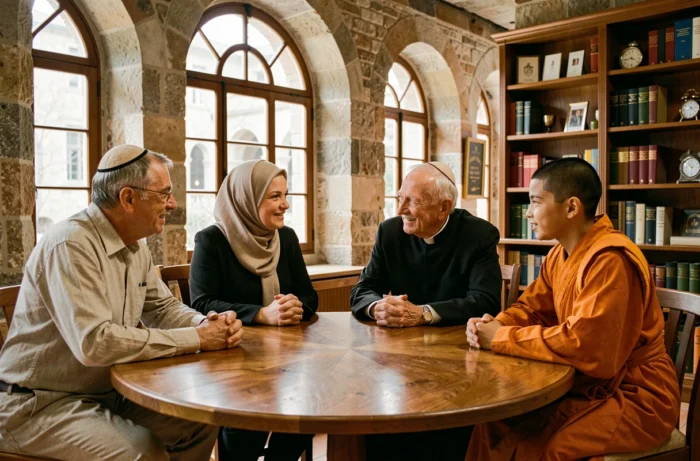
The interreligious dialogue structured by the Vatican for six decades is based on a precise conceptual architecture, codified by four complementary forms: dialogue of life, dialogue of works, theological dialogue, and dialogue of religious experience.
The note published in September 2026, titled Sixty Years of Interreligious Dialogue and Fraternity in the Light of Nostra aetate, reconfigures these categories by explicitly integrating contemporary geopolitical and educational issues. The Parvis des Gentils is situated at the intersection of these forms, but its function has evolved well beyond mere symbolic meeting.
Religious Literacy and Structured Dialogue Training
The Vatican note of 2026 marks an operational turning point. It no longer merely encourages goodwill between believers and non-believers: it recommends a systematic strengthening of interreligious dialogue education in seminaries, theological institutes, and pastoral programs.
This requirement for structured training reflects a reality: dialogue participants often lack analytical tools to approach religious traditions other than their own. The promotion of “religious literacy” aims to correct this deficit. We observe that this orientation extends beyond the ecclesial framework to touch civil educational institutions.
The initiative led by the Parvis des Gentils aligns with this logic by organizing exchanges that require intellectual preparation from participants, not just a willingness to engage in dialogue. The difference between a productive interreligious conference and a superficial roundtable lies precisely in this requirement for prior competence.
Four Forms of Interreligious Dialogue: A Framework Practiced by the Parvis des Gentils
The Vatican now more explicitly distinguishes four complementary forms of dialogue. Each responds to a distinct context and purpose.
- The dialogue of life concerns daily coexistence between neighbors of different faiths, without a theological agenda. It is based on mutual respect in ordinary interactions.
- The dialogue of works engages believers and non-believers in common humanitarian, educational, or social projects. The 2026 note emphasizes the development of shared educational projects between religious traditions.
- The theological dialogue mobilizes specialists to deepen mutual understanding of doctrines, without seeking to merge them.
- The dialogue of religious experience, sometimes monastic, fosters the sharing of spiritual practices between traditions, respecting each one’s identity.
The Parvis des Gentils does not limit itself to just one of these forms. Its uniqueness lies in the articulation of theological dialogue with the dialogue of works, inviting both agnostic philosophers and religious leaders to confront their frameworks of thought on concrete issues.
Religious Identity and Rejection of Syncretism in Dialogue
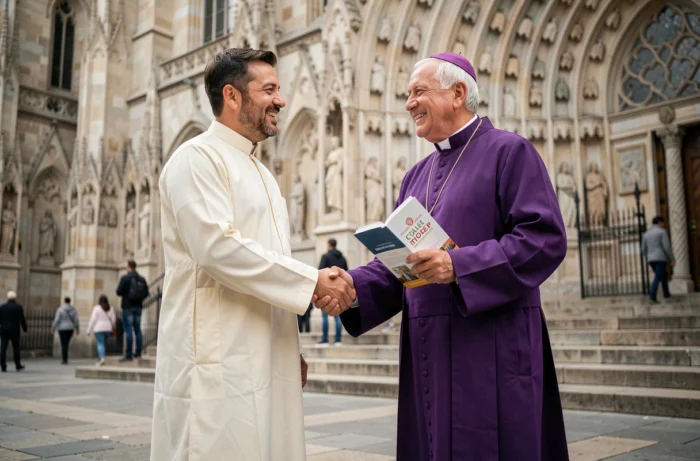
A point that mainstream articles rarely address rigorously: the interreligious dialogue as conceived by the Vatican excludes any syncretistic drift. The 2026 note states this unequivocally. It is neither about building a common religion nor diluting confessional identities into a vague consensus.
This limit directly structures the functioning of the Parvis des Gentils. Participants are not invited to find a common doctrinal denominator. They are invited to present their tradition clearly, to listen to that of others, and to identify areas of cooperation without theological confusion.
For the Catholic Church, this stance is rooted in a conviction: fidelity to Christ is non-negotiable in dialogue. Christian hope remains the foundation from which the exchange makes sense, not an element among others to be relativized.
Dialogue and Geopolitics: A Recent Dimension
The Vatican note of 2026 innovates by calling for the integration of current cultural and geopolitical issues into interreligious exchanges. This orientation reflects an awareness: contemporary conflicts instrumentalize religious identities, and dialogue cannot remain confined to academic salons.
The Parvis des Gentils has already begun this shift by hosting discussions on coexistence in plural societies, beyond just the European framework. This dynamic of confrontation between on-the-ground issues and theological reflection marks a concrete evolution in the practice of dialogue.
Nostra aetate, Sixty Years Later: What Has Changed in Method
Nostra aetate, adopted in 1965 during the Second Vatican Council, laid the foundations for Catholic interreligious dialogue. Six decades later, the method has significantly matured.
The first decades favored symbolic encounters: handshakes between religious leaders, joint declarations on peace and fraternity. We observe that the current phase demands concrete results: shared educational projects, cross-training programs, measurable humanitarian cooperation.
Religious diversity, far from being an obstacle to dialogue, is its condition of possibility. This assertion takes on particular significance when confronted with the temptations of identity retreat that traverse all traditions.
- Training for dialogue in seminaries remains uneven across countries and dioceses, despite Vatican recommendations.
- Interreligious educational projects struggle to find sustainable funding outside major metropolitan areas.
- The participation of non-believers in dialogue, a specificity of the Parvis des Gentils since its inception, remains marginal in most local interreligious initiatives.
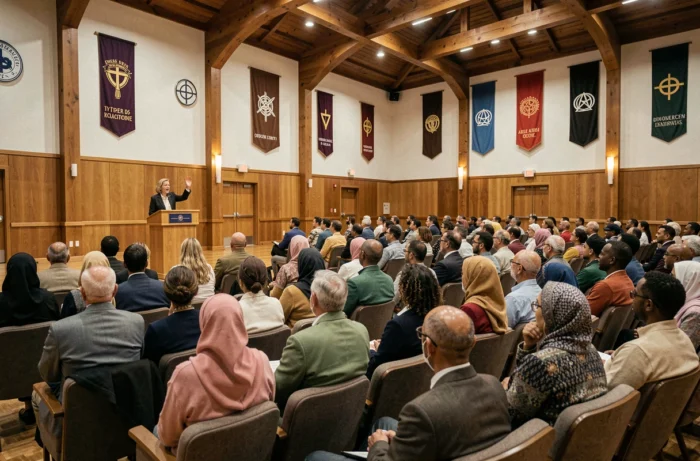
The shift from goodwill dialogue to a structured, trained dialogue grounded in geopolitical realities represents the most significant transformation in recent years. The Parvis des Gentils, by maintaining openness to non-believers while demanding intellectual rigor from participants, embodies this evolution better than most competing initiatives. The next step, following the Vatican trajectory, will involve the concrete evaluation of the results of these exchanges, not just their multiplication.