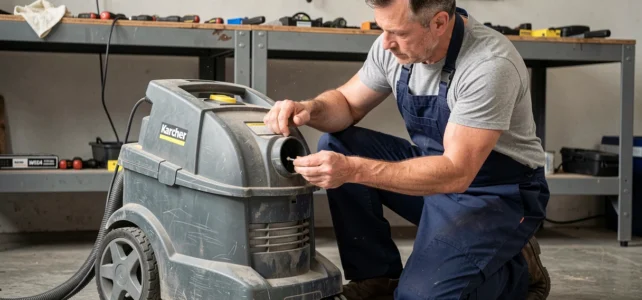
A Kärcher WD4 that loses suction power after a few jobs is rarely a motor failure. In the vast majority of cases, the problem comes from a clogged flat pleated filter or a partially obstructed hose. Before ordering parts, a methodical disassembly and a thorough cleaning are usually enough to restore original performance.
Flat pleated filter of the Kärcher WD4: the main culprit for loss of suction
When vacuuming fine dust from plaster, ash, or sawdust, the flat pleated filter clogs much faster than with coarse debris. This is noticeable by a higher-pitched motor noise and a drop in suction within a few minutes of use.
Kärcher recommends cleaning the foam filter and the motor protection filter after each use. This frequency may seem surprising, but it extends the lifespan of the pleated filter and protects the motor from fine particles that pass through a clogged filter.
To remove the flat pleated filter, unlock the head of the device, lift the cover, and then extract the filter cassette by turning it a quarter turn. No tools are needed. Gently tap the cassette against a hard surface to dislodge most of the dust.
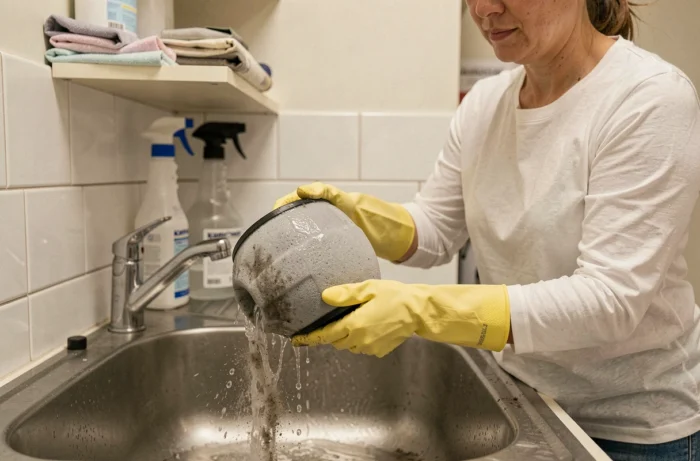
A rinse with lukewarm water, without detergent, removes residues embedded in the folds. One point not to overlook: let the filter dry for at least 24 hours before reassembling. A damp filter reduces suction and may emit an unpleasant odor.
Several detailed resources can be found for disassembling and cleaning a Kärcher WD4 vacuum cleaner depending on the type of filter installed and the level of clogging.
Disassembly of the hose and suction tubes: unclogging without force
The suction hose of the WD4 can be disconnected by hand, both at the device side and the handle side. If suction remains weak after cleaning the filter, this is often where the blockage is hidden.
To inspect the hose, stretch it straight and look through it. A blockage of compact dust, hair, or debris typically forms in the bend near the handle. It can be dislodged with a broom handle or a garden hose under moderate pressure.
- Check that the rubber seals at both ends of the hose are not cracked, as an air leak at this point can halve the suction power or more
- Inspect the inside of the rigid plastic tubes by disconnecting them one by one, as some debris can get stuck at the junction between two tubes
- Check the suction inlet on the tank itself, where a mass of fibers can form around the internal grid
One point where feedback varies: some users put the hose in the dishwasher for a deep clean. The plastic of the WD4 generally withstands this, but temperatures above 60 °C should be avoided to prevent deforming the connections.
Cleaning the tank and maintaining the filter bag
The stainless steel tank of the WD4 is resistant to both water and shocks. After vacuuming liquids, it should be emptied and rinsed quickly to avoid limescale deposits or mold at the bottom.
Removing the filter bag before any liquid vacuuming remains the basic rule. The paper or non-woven filter bag is not designed for water, and a wet bag tears, releasing dust directly into the pleated filter and the motor.
To clean the tank thoroughly:
- Remove all internal accessories (filter cassette, bag, motor protection foam)
- Rinse the tank with a water jet, paying special attention to the bottom and lower walls where residues dry
- Wipe the sealing joints of the lid with a damp cloth to ensure a good seal
- Leave the tank open for a few hours for complete drying before reassembling everything
Switch and accessory socket: the elements we forget to check
The WD4 has an on/off switch and, depending on the versions, a socket for plugging in a power tool. If the device no longer starts or cuts out intermittently, cleaning the switch contacts often resolves the issue.
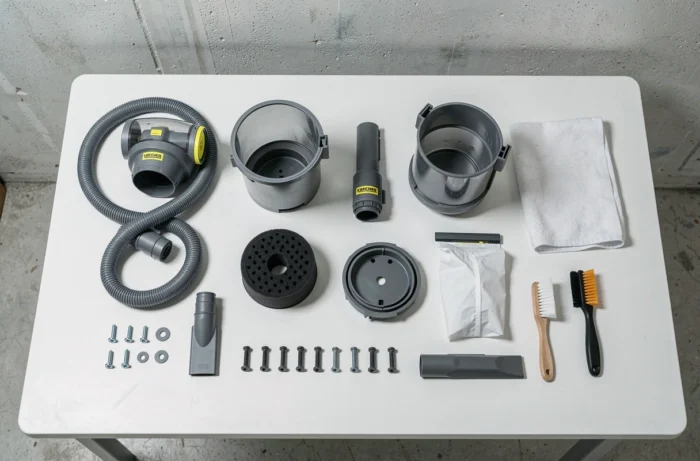
Remove the top cover (a few accessible cross screws without extensive disassembly) and blow out the accumulated dust around the switch with compressed air. Fine particles of plaster or wood infiltrate everywhere and eventually create false contacts.
On the accessory socket, an excess of dust can cause an electric arc when plugging in. A quick wipe with a dry cloth and a blast of compressed air are sufficient. If the socket is blackened, gently rub the contacts with a cotton swab soaked in isopropyl alcohol, with the device unplugged.
Warranty and right to repair: what changes in France
Since August 2026, the legal warranty of conformity in France states that a repair carried out during the two-year warranty extends this warranty by one year instead of six months. For a device like the WD4, this means that in the event of a covered failure, choosing repair over replacement offers longer protection.
This development encourages self-maintenance of the device for routine operations (filters, hose, tank) and reserves the use of Kärcher’s after-sales service for motor failures or manufacturing defects, while keeping the purchase receipt to claim the extended warranty.
A regularly cleaned pleated filter, a hose inspected after each major job, and a tank rinsed after liquid vacuuming: these three actions cover almost all performance drops of the WD4. The rest is simple mechanics accessible without training or specific tools.