
What fashion trends are truly shaping wardrobes this season, and on what criteria can they be distinguished from a mere buzz effect? Between the return of cuts inherited from the 70s, the rise of second-hand clothing, and new European regulatory constraints, the parameters that shape daily style go far beyond the choice of a color or a print.
ESPR Regulation and Destruction of Unsold Goods: What Changes for Fashion in 2026
Since July 19, 2026, large fashion companies operating in the European Union are no longer allowed to destroy their unsold new clothing, accessories, and shoes, except for strictly regulated safety or deterioration reasons. This ban stems from the European ESPR regulation (Ecodesign for Sustainable Products Regulation, regulation (EU) 2024/1781), which came into effect in July 2024.
In February 2026, the European Commission adopted measures detailing the residual cases where destruction remains permitted. For brands, this means a concrete shift towards resale, donation, or preparation for reuse rather than incineration or landfill.
This regulatory framework directly impacts the collections offered in stores. A brand that can no longer clear its surplus by destruction has every interest in producing fewer references, better calibrating its volumes, and favoring long-lasting pieces. To follow fashion trends on Oka Mag, this regulatory shift deserves to be kept in mind: it reshapes the offering well beyond the runways.

Spring-Summer and Autumn-Winter Fashion Trends: Comparative Table of Dominant Styles
Recent collections show different orientations depending on the season. The table below summarizes the main trends observed on the runways and in selections from specialized media.
| Criterion | Spring-Summer 2026 | Autumn-Winter 2026 |
|---|---|---|
| Key Cuts | Barrel jeans, high-waisted micro shorts, overalls | 90s fitted black pants, short trench coat |
| Color Palette | Butter yellow, pop tones, saturated pastels | Neutral tones, burgundy, minimalist black |
| Preferred Materials | Crochet, linen, fluid cotton | Velvet, structured wool, soft leather |
| Accessories | Wicker baskets, strappy sandals | Ruched loafers, structured bags |
| Stylistic References | 60s-70s (Twiggy, Jane Birkin) | 90s minimalism |
The contrast between the two seasons is clear. Spring-summer focuses on light materials and bright colors, while autumn-winter returns to a structured sobriety. However, a common thread persists: the reduction in the number of pieces in favor of reworked basics.
Second-Hand and Resale Market: A Growing Influence on Clothing Choices
The French second-hand textile market has reached 14 billion euros according to the latest available estimates. This growth is no longer marginal: it redefines how consumers approach their style.
In terms of trends, second-hand favors pieces with a strong visual identity. A barrel jean or a colorful short jacket resells better than a basic without character. Second-hand buyers look for recognizable cuts and durable materials, prompting brands to integrate these criteria from the design stage.
- Crochet and linen pieces, highly present on the spring-summer runways, lend themselves well to resale due to their resistance to repeated washing
- The barrel jean, a key cut of the season, retains its value in the second-hand market due to its distinctive silhouette
- Structured accessories (wicker baskets, ruched loafers) circulate easily from one owner to another without visible loss of quality
This dynamic also changes the purchasing rhythm. Rather than renewing an entire wardrobe each season, a growing share of consumers prefers the targeted acquisition of standout pieces, which are then resold to finance the next purchase.
Colors and Cuts to Adopt: Decoding the Season’s Choices
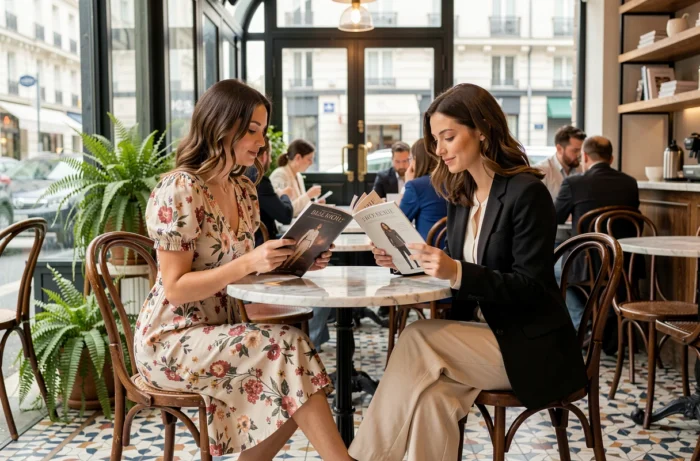
Butter yellow emerges as the most visible color of spring-summer 2026. This warm tone can be worn as a total look or as a unique touch on a top piece. In contrast, pop tones (bright orange, acid green) work better as accessories or details, at the risk of overwhelming the silhouette.
Regarding cuts, the oversized sweater remains a basic transitional piece between seasons. Worn over barrel jeans, it creates a voluminous silhouette on top and a fitted one below, a balance that cyclically returns in collections. The short trench coat, on the other hand, is gradually replacing the classic mid-length trench for urban mid-seasons.
Floral Prints and Crochet: Two Distinct Registers
Floral prints dominate long dresses and blouses of the warm season. Crochet, on the other hand, plays on texture rather than pattern. Mixing the two in the same outfit is the most common style trap: visual overload cancels out the desired effect.
Crochet works best as a standalone piece (dress, top, or bag) paired with solid basics. Floral prints gain impact on simple cuts, a straight skirt or a fitted shirt, rather than on voluminous shapes that disperse the gaze.
AGEC Law and Textile Labeling in France: A Framework that Guides Purchases
Alongside the European ESPR regulation, France applies the AGEC law (Anti-Waste for a Circular Economy), which imposes specific obligations on textile brands. Among them, the display of traceability and the gradual prohibition of certain practices related to unsold goods.
For consumers, these constraints translate into clearer information about the origin of clothing and their composition. A seasonal purchase, whether it’s a linen dress or a barrel jean, can now be evaluated on objective criteria beyond style: durability of materials, manufacturing conditions, resale or recycling potential.
Current fashion trends are no longer limited to a runway or a color palette. The European regulatory framework, the rise of second-hand, and the demand for sustainability are changing purchasing decisions as much as aesthetic choices. The piece that transcends multiple seasons without losing its stylistic relevance or resale value becomes the true marker of a well-thought-out wardrobe.