
The baby products market in Europe is undergoing a period of regulatory tightening. Since December 2024, the European regulation GPSR (2023/988) imposes enhanced traceability on baby bottles, pacifiers, baby seats, and high chairs sold to young parents. Finding everything for baby is no longer just about going through a shopping list: product compliance, safety standards, and the legal framework change the selection criteria well before birth.
R129 Standard for Baby Car Seats: What Changed in 2024
Since September 2024, car seats approved under the old R44/04 standard can no longer be sold new in the European Union. Any seat purchased in-store or online must display the R129 (i-Size) label on its approval tag.
This shift has direct consequences for second-hand purchases. An R44/04 seat remains legal to use as long as it is not damaged, but it can no longer be marketed as new. Young parents turning to resale sites must check the label affixed to the seat shell to identify the applicable standard.
In France, the rear-facing position is mandatory up to 75 cm (about 15 months). Road safety experts recommend extending rear-facing until 105 cm, or about 4 years. This recommendation drives families to seek seats that allow prolonged use in this position, which alters the initial budget.
Several specialized stores offer ranges compliant with the i-Size standard, such as https://babys-corner.be/ which lists baby products meeting current European standards.
GPSR Regulation and Baby Products: Mandatory Traceability
The regulation (EU) 2023/988 on general product safety has been fully applicable since December 13, 2024. It directly targets equipment intended for infants and toddlers.
Specifically, every baby product sold in Europe must now include accessible technical documentation, clear identification of the manufacturer or importer, and a complete traceability chain. Cradles, strollers, baby baths, high chairs: all are affected.
What GPSR Changes for Online Purchases
Marketplaces are the primary targets. A baby bottle sold by a third-party seller on a platform must display the same traceability information as a product in a physical store. The absence of technical documentation can lead to the product being withdrawn from sale.
For parents, this means that a product sold on a European platform without mention of the manufacturer or without a compliance notice presents a warning signal. Field reports vary on this point: some platforms enforce the regulation rigorously, while others lag in ensuring compliance from their third-party sellers.
Baby Care and Hygiene: Sorting Equipment by Actual Use
Baby registries often recommend about ten hygiene products. In practice, the first weeks focus on a limited number of daily tasks: diaper changes, bathing, and cord care.
- A fragrance-free body and hair wash, suitable for the newborn’s skin pH, covers all bathing needs for several months
- Newborn-sized diapers are consumed at a high rate in the first weeks, justifying a substantial initial stock rather than repeated purchases
- Physiological saline in single-dose vials remains the most versatile care product (eyes, nose, cord) and is least likely to cause skin reactions
- A stable changing table with edges is sufficient as a changing station, with the changing mat needing to be covered with a washable cover
Conversely, some accessories frequently listed (wipe warmer, UV sterilizer, connected bath thermometer) are more about comfort than necessity. The available data does not allow for a conclusion about a measurable health benefit of these devices compared to their simpler versions.
Breastfeeding and Portable Equipment: Balancing Bulk and Practicality
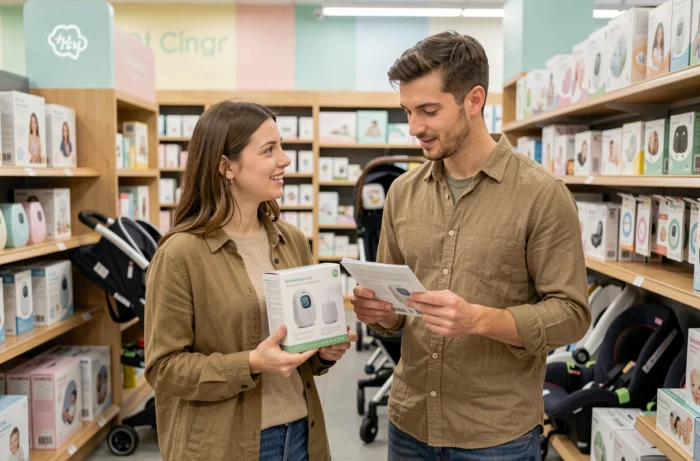
The choice of breastfeeding or bottle-feeding equipment depends as much on lifestyle as on the type of feeding chosen. A compact electric breast pump is helpful for parents returning to work early, but it represents a significant investment for use that may be limited to a few weeks.
For travel, the diaper bag remains the most cited equipment by parents as genuinely useful on a daily basis. Models with integrated insulated compartments replace the portable bottle warmer in most common situations.
Stroller and Transport: The All-in-One Trap
Trio systems (bassinet, car seat, hammock) appeal due to their apparent completeness. Their total weight often exceeds what parents anticipate, and the bassinet becomes unnecessary after a few months. A chassis compatible with an i-Size car seat and a hammock constitutes a more realistic duo for urban use.
- Checking compatibility between the car seat and stroller chassis before purchase avoids needing an additional adapter
- The folded weight of the chassis determines actual use: beyond a certain threshold, storage in a trunk or apartment becomes cumbersome
- Inflatable wheels improve comfort on uneven terrain but require maintenance that solid wheels do not
Equipment suited to the home and daily transport mode provides more services than a versatile product that does not fulfill any function appropriately. Space constraints, stairs, or public transport filter options much more effectively than a product sheet.
The European regulatory framework has raised the safety floor for baby equipment, but it has not simplified the purchasing process. Every baby product deserves a compliance check, not just a price comparison. Approval labels and traceability mentions have become selection criteria on par with comfort or design.