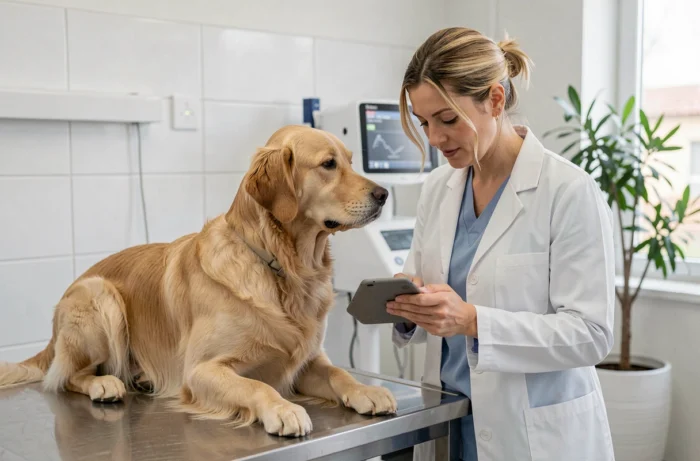
GMVet1 is an online veterinary software designed to centralize clinic management, from patient records to billing. Its cloud architecture makes it accessible from any browser, without local installation or operating system constraints.
This technical feature changes the way practices organize their daily operations, but it also raises concrete questions about the hosting of health data and the regulatory limits of certain functions, such as remote veterinary advice.
Remote advice and veterinary teleconsultation: what GMVet1 really allows
A point rarely clarified in the software presentations concerns the distinction between remote advice and regulatory teleconsultation. In France, the decree officially regulating veterinary teleconsultation has not yet been signed. Therefore, GMVet1 does not qualify any act as teleconsultation in the legal sense of the term.
Nevertheless, the software integrates functional components that allow for documenting a remote exchange with the pet owner: photos, videos, reports attached to the patient record. These elements remain within the scope of informal advice, distinct from a regulated medical act.
To better understand the impact of GMVet1 on our animals, it is important to keep this nuance in mind: the solution facilitates remote follow-up without claiming to replace the physical consultation, as long as the legal framework has not evolved.
HDS Hosting and Veterinary Data Security
A cloud software that stores animal medical records also handles personal data of the owners. The HDS certification (Health Data Host) imposes a precise technical framework on providers hosting this type of information in France.
The HDS framework has been recently updated to strengthen security requirements, particularly regarding subcontracting and server location. For a SaaS publisher like GMVet, this means that the chosen host must meet strict criteria:
- Encryption of data at rest and in transit, with documented key management
- Complete traceability of access to patient records and proprietary information
- Digital sovereignty clause specifying the geographical location of servers and the absence of transfer outside the European Union
These constraints are not unique to GMVet1, but they determine the level of trust that veterinarians can place in the solution. A cloud software without valid HDS certification exposes the clinic to regulatory risk regarding data protection.
Digital Sovereignty Clause: A Recent Criterion
Recent parliamentary discussions around the Health Data Hub have highlighted the issue of the sovereignty of hosted data. For veterinary clinics, the stakes are comparable to those in the human medical sector: knowing precisely where the data is stored and under which jurisdiction it falls.
GMVet1 operates via a browser, which simplifies updates and backups. The publisher ensures these operations in real-time, without the clinic’s intervention. This technical model implies that the responsibility for security largely rests with the host, not the veterinarian.
GMVet1 and GMVet2: Understanding the Migration Logic
The question of migrating to GMVet2 arises for already equipped structures. The two versions are not simple successive updates: GMVet2 is based on a reworked architecture, with complementary modules and a distinct pricing model.
Before considering migration, several points deserve concrete analysis:
- Compatibility of existing data with the new architecture (patient history, prescriptions, accounting)
- Actual cost of the transition, including team training and potential dual operation period
- Features actually used by the clinic, as some new features of GMVet2 only concern multi-site structures
Migrating without having mapped out needs is akin to changing tools without resolving existing issues. A clinic that primarily uses inventory management and billing does not have the same priorities as a multi-site veterinary group that needs to share patient records between establishments.
Multi-Site Management and Veterinary Activity Control with GMVet
One of GMVet’s technical strengths lies in its ability to operate in multi-site environments without a dedicated local network. Each additional site is configured directly from the interface, and client and patient files are shared between establishments.
For structures employing substitutes, specialized veterinary assistants (ASV), or licensed freelance assistants (ALD), the integration of new users occurs without hardware deployment. An identifier and a browser are sufficient.
Performance Indicators for Daily Operations
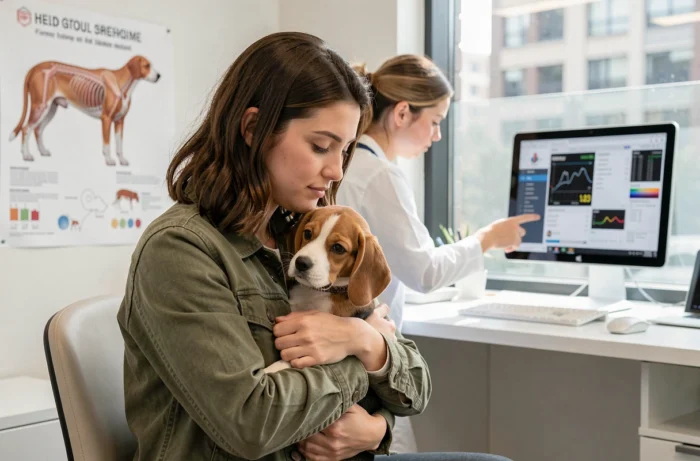
The software offers activity indicators designed to track the profitability of each site. Revenues, unpaid bills, appointment slot occupancy rates: this data allows for adjustments in pricing policy or identifying imbalances between sites.
Client communication (reminders, targeted messages via SMS or email) is also managed from the platform. The veterinarian selects the target, content, and channel, reducing reliance on third-party tools for managing owner relationships.
Choosing veterinary software is not just about a list of features. Compliance with hosting regulations, a clear distinction between remote advice and teleconsultation, and the actual relevance of migrating to a newer version weigh as heavily as daily usability. For a clinic treating dogs, cats, or livestock, the reliability of the patient record remains the foundation upon which everything else relies.