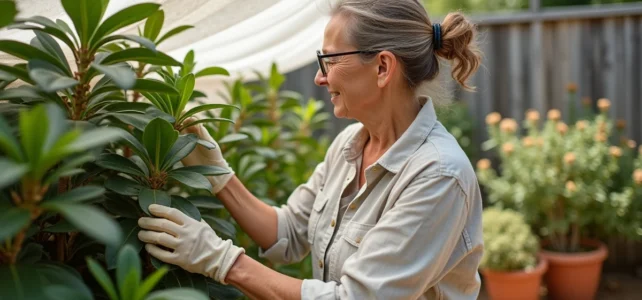
The rhododendron is an undergrowth plant. Its natural habitat is the shade filtered by the canopy, consistently cool soil, and high ambient humidity. When the thermometer rises for several consecutive days, these conditions disappear, and the plant suffers quickly. Protecting the rhododendron during a heatwave requires recreating, even in a makeshift way, this original microclimate.
East or northeast exposure: the parameter that watering cannot replace
You may have noticed that some rhododendrons go through the summer without a hitch while others scorch just a few meters away? The difference is rarely due to watering. It is due to orientation.
A rhododendron planted facing south or west receives the afternoon sun, which is the most aggressive. Even when generously watered, its foliage overheats, and its stomata close to limit transpiration. The plant survives, but it stops growing, and its leaves begin to yellow or curl in on themselves.
The ideal exposure is east or northeast. The rhododendron benefits from the gentle morning sun and then remains in the shade during critical hours. If your shrub is already in place on the south side, install a shade cloth or plant a deciduous tree nearby to filter the light between noon and 5 PM. It is also possible to protect the rhododendron during a heatwave by moving it in the fall to a better-oriented location, provided you prepare the root ball several weeks in advance.
Acidic and cool soil: creating a substrate that retains water without drowning the roots
The rhododendron grows in acidic soil, with a pH between 4.5 and 5.5. In a warm climate, the soil dries quickly on the surface. An ill-suited substrate turns into a compact block that repels water instead of absorbing it.
The effective mix combines heather soil, non-limestone garden soil, and compost. Heather soil provides acidity. Compost improves water retention. Garden soil gives structure for the roots to anchor properly.
The trap of pure potting soil
Many gardeners fill the planting hole with potting soil alone. Potting soil retains water well at first, but it compacts within a few months and forms a spongy mass that suffocates the roots. A mix in three equal parts remains aerated even after several seasons.
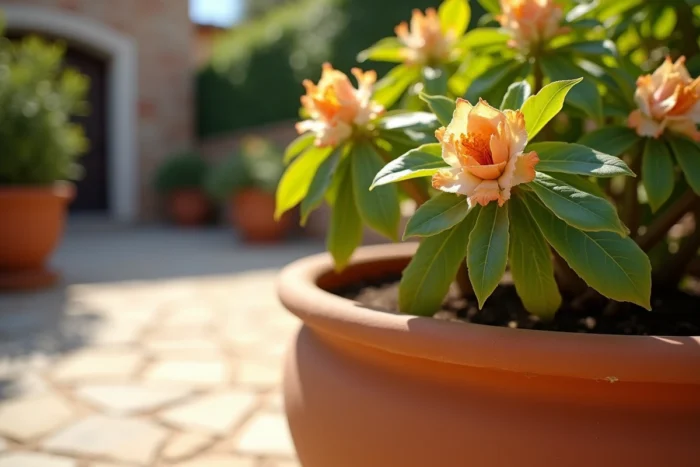
If your rhododendron is in a pot, the problem amplifies. The volume of substrate is limited, and the pot’s temperature rises quickly in the sun. A terracotta pot, being thicker, heats less than a black plastic pot. And a pot elevated on blocks allows air to circulate underneath, reducing heat buildup.
Evening watering and thick mulching: two actions that work together
Competitors talk a lot about watering at 10 PM. The advice is valid but incomplete without suitable mulching.
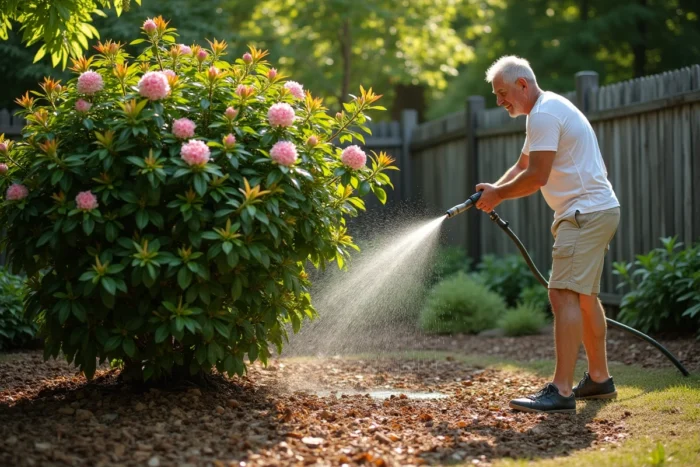
When the heat exceeds 30 °C, watering in the full afternoon causes thermal shock to the roots. Fresh water comes into contact with a scorching substrate. The root tissues can be damaged. Watering in the evening, once the soil temperature has started to drop, allows water to seep in slowly and the roots to absorb it overnight.
The mulch that keeps the soil cool until the next day
Without mulch, the water provided in the evening evaporates by the following morning. Mulch creates a barrier between the moist soil and direct sunlight. Acidic materials are better suited for the rhododendron:
- Pine bark slightly acidifies the soil as it decomposes and remains in place for several seasons without compacting.
- Conifer needles form a light mat that allows rainwater to pass through while limiting evaporation.
- Wood chips, provided they are not treated wood, offer a thick layer that thermally insulates the soil.
Spread the mulch to a sufficient thickness around the base, leaving a few centimeters of space around the collar to prevent rot. This simple action significantly reduces watering frequency.
Grilled leaves after a heatwave: assess the damage before taking action
After a heatwave, the rhododendron may show brown, dry, or curled leaves. The reflex of many gardeners is to prune immediately. This is a mistake.
Before cutting, scratch the bark of the stems with your nail. If the wood is green beneath the surface, the branch is alive. The burned leaves will fall off on their own, and the plant will regrow from the remaining buds. Pruning too early forces the rhododendron to mobilize energy for healing, while it needs all its reserves to recover.
If the stems are brown and dry inside, the branch is dead. In this case, cut above the first still-green node. Wait until autumn for a more thorough pruning if necessary.
Resuming watering without excess
A rhododendron stressed by heat should not receive fertilizer. The plant has closed its stomata and reduced its metabolism. Forcing growth with a nitrogen boost at this stage can worsen the situation. Resume regular evening watering, keep the mulch moist, and wait until the following spring to assess recovery and consider gentle fertilization.
The rhododendron is more resilient than it appears after a heatwave episode. A well-established plant, in acidic and cool soil, in the shade during the afternoon, can withstand several hot summers without lasting damage. The choice of location and soil preparation matter more than any catch-up watering.