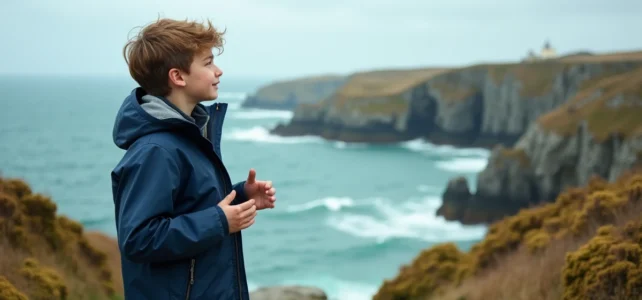
Brittany attracts entire families every summer, but traveling with a teenager requires a different filter when choosing activities. Animal parks and seaside walks are no longer enough: a 13 or 16-year-old seeks autonomy, physical challenges, and sometimes a narrative or social dimension in what they do. The Breton coastline and countryside offer these types of experiences, provided you know where to look beyond the classic tourist lists.
Outdoor escape games in Saint-Malo, Dinan, and Rennes
Competitors rarely mention this format, yet it has been structured for several years in various Breton cities. Booking platforms like GetYourGuide now offer scenarios playable outdoors, directly in the historic streets.
In Saint-Malo, a course titled “In the Wake of the Privateer” transforms the ramparts into a narrative playground. Dinan offers “The Symbols of the Apocalypse,” while Rennes has its own urban scenario, “By Order of the Peaky Renners.” These escape games combine treasure hunts, puzzles, and the discovery of local heritage.
What makes them particularly suitable for teenagers: the time slots can be booked online and played independently, without a parent needing to lead the group. The teen can bring one or two friends, solve the puzzles at their own pace, and explore a city without feeling like they are “visiting.” For those wondering what to do in Brittany with a teenager on Jeune Bretagne, this type of hybrid activity between play and culture deserves to be prioritized.
Water activities in Brittany: going beyond the classic sailing course
Surfing, kayaking, and paddleboarding are featured in all guides. The question is not to ignore them, but to understand what changes when talking about a teenager rather than an eight-year-old child.
A teen has the physical strength to access more technical disciplines. E-foiling (electric foil boarding) is practiced, for example, in Quiberon, with supervised sessions available for beginners. The sensation of flying above the water is radically different from paddleboarding, and it’s often this type of high-adrenaline activity that motivates a teenager to disconnect from their phone.
The Pointe de la Torche, in Finistère, remains a reference spot for surfing. Local schools offer courses tailored to young people, with supervision that takes into account fitness levels and the day’s weather. However, a teen who has already surfed elsewhere may find more novelty in coasteering (cliff climbing with jumps into the water), offered in certain areas of the northern coastline.
Criteria for choosing a water activity with a teenager
- The level of autonomy offered: some schools allow 14-17 year-olds to navigate alone after a briefing, while others require constant supervision.
- The actual weather of the day, not that of the day before: conditions change quickly on the Breton coast, and a slot booked three weeks in advance can fall through.
- The group effect: a teen alone in an adult class will disengage faster than a teen integrated into a small group of their peers.
Breton heritage and teenagers: bridging the gap
Taking a teenager to visit a castle or a local history museum can work, provided that the mediation is designed for this audience. Most Breton heritage sites have not yet adapted their scenography for 12-17 year-olds.
Some exceptions are worth noting. Océanopolis in Brest has recently undergone modernization, with a renovated tropical pavilion that incorporates immersive devices. For a teenager interested in marine biology or ecology, the visit goes beyond just an aquarium.
Fort la Latte, on the Emerald Coast, offers a spectacular setting facing the sea, but the visit itself remains quite traditional. The interest for a teen lies more in the natural site (cliffs, coastal path) than in the explanatory panels inside.
What really works with a teenager on a cultural visit
Formats that succeed share a common point: they give an active role to the visitor. A route with a smartphone app, an investigation to solve in a historical place, or a practical workshop (blacksmithing, stone carving, local cooking) captures attention much longer than a linear audio guide.
Field feedback varies on the ideal duration: some teenagers engage for two hours in a creative workshop, while others disengage after forty minutes in the best museum in the world. Planning a physical activity before or after a cultural visit remains the most reliable lever to maintain engagement throughout the day.
Adventure and nature in Morbihan and Ille-et-Vilaine
The Breton hinterland remains underutilized by families with teenagers, who often focus their stay on the coastline. The inland Morbihan and the Brocéliande forest in Ille-et-Vilaine, however, offer experiences distinct from the coast.
Tree climbing courses have multiplied in the region. A teenager’s interest depends on the number of truly engaging courses beyond the “family” level. Some parks offer black courses or zip lines several hundred meters long, which changes the game compared to a green course accessible from six years old.
The GR34, the customs path, can be broken down into short stages suitable for a half-day hike with a teenager. The section between Lorient and Guidel, in Morbihan, alternates beaches, coves, and wooded passages on varied terrain. Proposing a stage with a concrete objective (reaching an isolated cove, a specific viewpoint) is more motivating than a “nature walk” without a destination.
- Brocéliande for a hike with a mythological dimension, with sites like the Val sans Retour or Merlin’s tomb, which appeal even to teens who are not keen on walking.
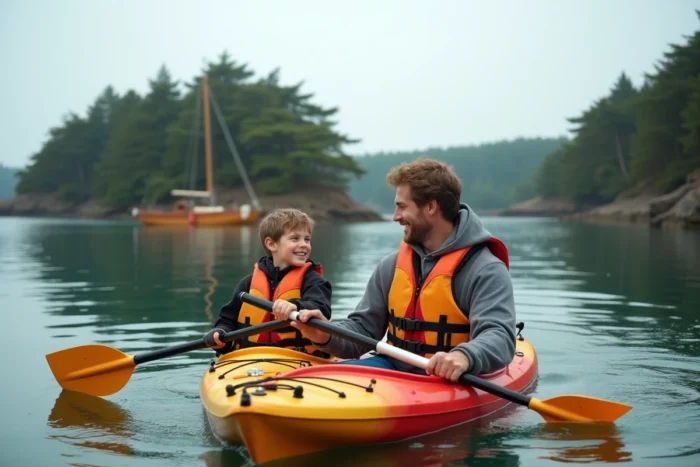
- The Gulf of Morbihan by sea kayak, to combine physical effort and island discovery.
- The pink granite moors, between Perros-Guirec and Trégastel, where the spectacular geology provides a visual excuse for walking.
Brittany with a teenager works better when we abandon the idea of a uniform family program. Mixing a morning of urban escape games with an afternoon of kayaking, or a short visit to Océanopolis followed by a surfing session, allows for covering the two fundamental needs of a teen on vacation: to be stimulated and to feel a sense of choice.