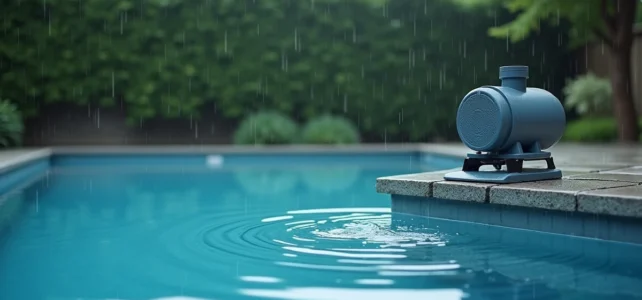
Leaving the pool pump running during a rain shower or turning it off as a precaution: the answer depends less on a single reflex than on several measurable parameters. Type of rain, electrical installation, protection of the technical room, and chemical state of the pool each guide the decision in a different direction. This article compares the situations to identify when filtration remains useful and when the electrical risk necessitates stopping.
Moderate rain or thunderstorm: two scenarios, two opposite decisions for the pump
The distinction between regular rain and a thunderstorm with lightning radically changes the course of action. Grouping both under the term “rain” leads to management errors.
| Parameter | Moderate rain (without thunderstorm) | Thunderstorm with lightning risk |
|---|---|---|
| Electrical risk for the pump | Low if the technical room is closed and the installation is up to standard | High, even with a technical room (possible surge) |
| Filtration decision | Recommended to maintain | Immediate stop |
| Access to the pool | Possible (swimming not recommended for comfort) | Prohibited, stay away from water and conductive structures |
| Waiting time after the last lightning | Not applicable | At least 30 minutes after the last thunder |
| Impact on water quality | Gradual decrease in pH, introduction of light debris | Same chemical impact, worsened by strong winds carrying leaves and dirt |
The Canadian Centre for Occupational Health and Safety reminds us that there is no truly safe place outdoors during a thunderstorm and recommends staying away from any conductive structure, water, and electrical installations. Asking whether can the pool pump operate in the rain thus first involves identifying whether there is a risk of lightning or not.
Under simple rain, filtration protects the pool; under a thunderstorm, it is the installation that needs protection.
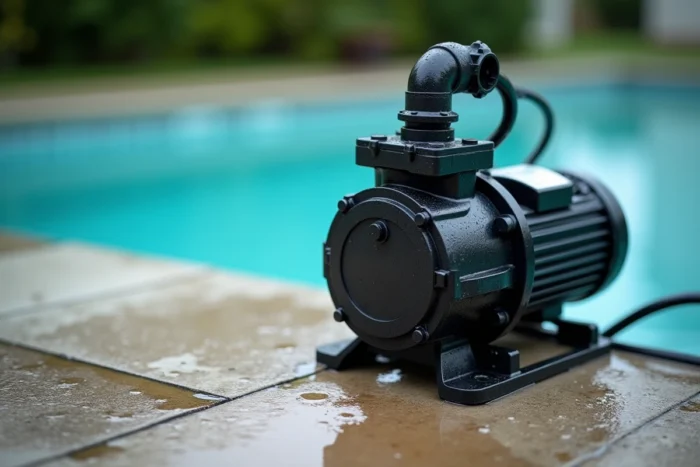
Filtration in the rain: what rainwater really does to the pool
Rainwater is not chemically neutral. Its pH is generally lower than that of treated pool water. When mixed with the pool volume, it pulls the pH down.
This acidification has direct consequences on treatment. Chlorine loses effectiveness when the pH drops too low, promoting algae growth and the proliferation of microorganisms. Rain also carries atmospheric pollutants, pollen, and dust that overload the filter.
Maintaining filtration during the shower limits three concrete problems
- Accumulation of debris on the surface: skimmers suck up leaves, insects, and fine particles before they sink to the bottom of the pool, where their removal requires manual cleaning
- Stagnation of water: without circulation, the upper layers (diluted by rain) do not mix with the rest of the volume, creating areas where treatment no longer works
- Prolonged chemical imbalance: circulation forces water through the filter and facilitates the even distribution of chlorine or treatment product
After a prolonged shower, checking the pH and adjusting the treatment remains necessary, even if the pump has been running throughout the rain. Filtration does not correct the chemical imbalance; it slows its progression.
Electrical protection of the pool pump: standards and devices to check
The real technical issue is not so much the rain as the state of the electrical installation powering the pump. A pump installed in a closed technical room and connected to a protected circuit can operate in the rain without particular risk.
On the other hand, an exposed pump, powered by an extension cord or connected to a panel without an appropriate residual current device, poses a problem regardless of the weather. The rain only exacerbates a pre-existing fault.
Three points to check before leaving the pump running
- 30 mA residual current device: this device cuts off power in a fraction of a second as soon as an imbalance of a few milliamperes is detected between phase and neutral, significantly reducing the risk of electric shock
- Protection rating (IP) of the pump: a pump designed for outdoor use must have a sufficient IP rating to withstand water splashes. Check the nameplate
- Condition of the technical room: a well-ventilated room, without leaks, with watertight connections, provides sufficient protection for moderate rain. A room with a poorly closing door or a leaking roof exposes equipment to moisture
Without these protections, allowing a pump to operate in heavy rain is considered an unacceptable electrical risk in modern installations.
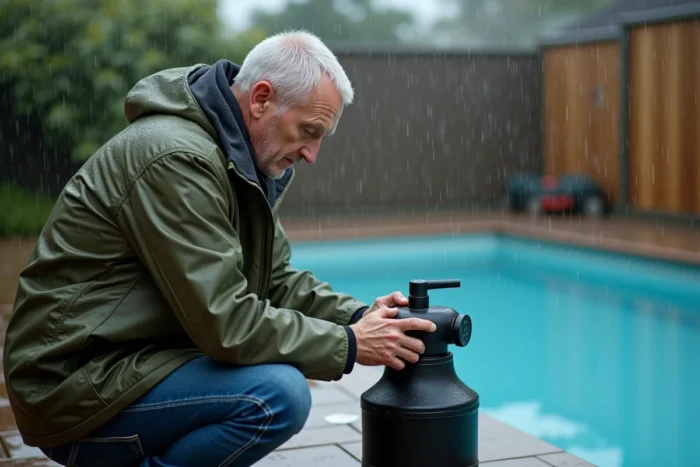
Filtration duration after the rain: should the cycle be extended
The introduction of untreated water into the pool alters the ratio between the volume of filtered water and the total volume. After heavy rain, the usual filtration duration may not be sufficient to renew the entire volume.
The commonly applied rule is to extend filtration for a few hours after a significant rain event. This extension allows the filter to process the excess impurities introduced by the rain and restore a homogeneous circulation of the treatment product.
Checking the pH and chlorine level immediately after the rain allows for treatment adjustments before algae can take advantage of the imbalance. A corrective pH addition and slight over-chlorination accelerate the return to normal values.
If the pool has overflowed due to the volume of rain, the water level must be brought down to mid-skimmer for proper suction to function. Water that is too high prevents skimmers from creating the necessary surface current for removing floating debris.
The pool pump in the rain does not call for a binary response. The determining factor remains the distinction between simple rain and thunderstorm: in the first case, active filtration preserves water quality; in the second, electrical safety takes precedence over pool maintenance. Checking the state of the electrical circuit and technical room before the rainy season avoids having to make this decision in an emergency.