
You have a ready manuscript, an editorial project in mind, and a concrete question: how to go from a PDF file to a physical book without waiting weeks? Quick online book printing meets this specific need. It relies on a digital process that eliminates the cumbersome steps of traditional printing, allowing you to receive copies in just a few days, sometimes starting from a single unit.
Digital printing and offset printing: what changes for a publishing project
Before discussing speed, it’s essential to understand what happens behind the scenes. Offset printing, used for decades, works with engraved aluminum plates for each page. This system produces excellent quality, but it is expensive to prepare. The price only becomes attractive when ordering several hundred copies.
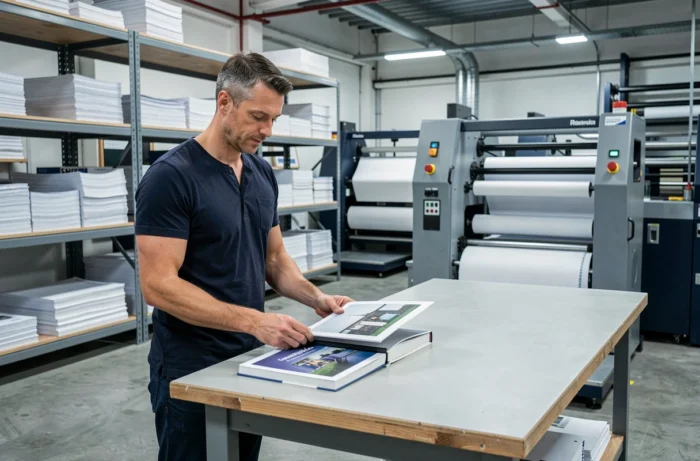
Digital printing works differently. The PDF file is sent directly to the machine, without plates or setup. No minimum print run is required to start production. A single copy can come off the press with quality comparable to that of a book distributed in bookstores.
For a self-published author, an association, or a small publishing house, this difference is crucial. It allows testing a book with a small number of copies, adjusting the content or cover, and then restarting production without additional setup costs. Choosing quick online book printing eliminates the financial risk associated with unsold stock.
Automatic PDF file checking: an often underestimated time saver
Have you ever sent a file to a printer only to discover, three days later, that the margins were too narrow or that the image resolution was problematic? Online printing platforms have developed tools that address this issue upfront.
Specifically, when you upload your PDF, the system automatically analyzes the document. It checks the dimensions, bleed, image resolution, and font compatibility. Some platforms even offer a 3D preview of the finished book before order confirmation.
This automated check significantly reduces the number of technical rejections and back-and-forth emails with an operator. For a self-publishing project managed alone, without a professional layout designer, it is a valuable safety net. Several online services also provide ready-to-use layout templates, making file preparation easier from the start.
Automated flow and international distribution: publishing without logistical borders
Online book printing is no longer limited to producing an object. Some platforms now integrate ordering, manufacturing, and shipping into a single flow, connected by APIs to e-commerce sites or marketplaces.
Why does this detail matter? Because it changes the very logic of the publishing project. Instead of printing a stock, storing it at home, and then managing shipments one by one, the book is produced only when a reader places an order. The platform handles printing and direct shipping.
Some services cover over 150 countries and territories for delivery. An author based in France can sell to a reader in Canada without managing stock or customs. This model, often referred to as print on demand (POD), transforms independent publishing into a viable activity without heavy logistical investment.
Elements to check before choosing a platform
Not all platforms offer the same options. Before finalizing your choice, a few criteria deserve particular attention:
- The available formats: check that the desired format (paperback, A5, A4, or custom size) is indeed offered, as some platforms limit dimensions.
- The types of binding: perfect bound, stapled, hardcover, or softcover. The choice of binding influences the final appearance and unit price.
- The paper and lamination options: standard offset paper does not have the same feel as coated paper. Matte or glossy lamination on the cover protects the book and alters its appearance.
- The actual production and delivery times: “quick printing” does not mean the same thing everywhere. Compare the announced timelines excluding weekends and holidays.

Online printing quality: what to expect concretely
A common concern among authors discovering digital printing is: will the quality match that of a book bought in a bookstore? The answer depends on a few technical parameters, but it is generally positive.
Current digital machines achieve resolutions that make the difference with offset printing almost imperceptible to a reader. For black and white text, the result is identical. For color, fidelity depends on the color profile of the file and the type of paper chosen.
The factors that influence perceived quality are not always what one might expect. The weight of the interior paper, the durability of the glued spine after several openings, the sharpness of the cover: these details matter more than the printing technology itself. Paper that is too thin gives a cheap impression, even with excellent resolution.
A simple test before launching a print run
Order a single copy. Flip through it, fold it, leave it open on a table for a day. A test copy costs just a few euros and avoids unpleasant surprises on a larger batch. This step is made possible by the absence of a minimum order requirement, and it is one of the most tangible advantages of the unit model.
Ultimately, the choice of an online printing platform for a publishing project rests on three pillars: technical compatibility with your file, the physical quality of the produced book, and the logistical flexibility of the service. The unit price decreases as volume increases, but the real advantage remains the ability to publish without stock, without commitment, and with complete control over the final result.