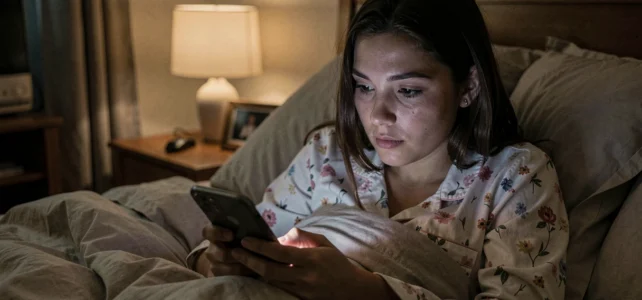
The Snap score is a counter that adds up the snaps sent and received, as well as the stories published on the account. Text messages (chats) are not included in this calculation. When this number rises during the night while the phone is sitting on the nightstand, the logical reaction is to seek an explanation, whether technical or relational.
Delayed Snap score update: the display lag
The most common phenomenon behind a Snap score that increases overnight is nothing mysterious. Snapchat does not always update the score in real-time. The app processes updates in batches: points accumulated during the day or evening may be counted all at once, and then displayed after a period of inactivity or upon reopening the app.
Specifically, a user who sends about twenty snaps between 8 PM and 11 PM may not see their score change immediately. The server processes these interactions, and the new score display may not appear until several hours later. For someone checking the profile at 2 AM, the point jump seems nocturnal when it actually reflects activity from the previous evening.
This lag explains why observing a Snap score that increases overnight does not mean that the user is active at that precise moment. The visible increase corresponds to a catch-up display, not a live connection.
Time zones and international contacts on Snapchat
A often overlooked factor: friends located in a different time zone. When a contact sends a snap from a country where it is still daytime, the recipient receives this snap while it is the middle of the night in their own geographical area.
The recipient’s score increases as soon as the snap is received by the server, even if the phone is locked. For someone with friends in Canada, the United States, or Asia, this mechanism produces regular increases during European sleeping hours.
The sender’s score also rises. If you are monitoring a friend’s snapscore and they are exchanging snaps with people located on a different continent, their apparent nighttime activity is actually daytime in another time zone.
Distinguishing real activity from phantom activity on Snapchat
The real useful question is not so much “why does the score rise at night” but “how can you tell if someone is actually active at that moment.” The score alone does not provide this information. Several elements help to put a nighttime increase into perspective:
- Stories published in the evening generate points that accumulate as other users view them, without any additional action from the author.
- Flames (streaks) maintained at the end of the day count the sending and receiving of snaps. A quick exchange before midnight to maintain a streak can raise the score by several points at once.
- Snapchat groups amplify the phenomenon: a single snap sent in a group of ten people generates points for each reception, and these receptions are spread out over time according to the members’ connections.
- An active Bitmoji on the Snap Map or the “online” status are more reliable indicators than a simple score movement to determine if someone is using the app in real-time.
Snapchat score and relational trust: what the number doesn’t say
Monitoring a partner’s or friend’s snapscore at night has become a common reflex, fueled by the relational anxiety that social networks can generate. The score reveals neither the identity of contacts, nor the content of exchanges, nor the context in which they occurred.
A score that rises by several dozen points overnight may correspond to snaps sent to colleagues in the evening, stories viewed by other users, or simply a timing discrepancy between the server and the display. None of these situations imply an ongoing conversation at 3 AM.
The mechanics of Snapchat rely on gamification: flames, trophies, and the score itself encourage frequent interaction. This design promotes the sending of quick, sometimes automatic snaps to maintain active streaks. The score measures a volume of interactions, not an intention.
Checking Snap activity without misinterpreting
Before jumping to conclusions from a score that moves at night, a few technical markers help to make a more reliable diagnosis:
- Comparing the score at two specific moments (for example, before bed and upon waking) allows you to measure the actual amplitude of the increase. A variation of a few points corresponds to automatic receptions or delayed processing.
- The Bitmoji status on the Snap Map, when shared, indicates recent activity more accurately than the score.
- Notifications of received snaps timestamp the exchanges, providing a temporal context that the score alone does not offer.
The Snapchat score remains a raw counter, designed to encourage engagement on the platform. Its nighttime progression is almost always due to technical mechanisms (batch processing, time zones, grouped receptions) rather than secret real-time activity. Keeping this functionality in mind prevents turning a simple number into a source of conflict.