Italian first names of biblical origin are not just a decorative list. Their Italianized form alters the phonetics, sometimes the perceived meaning, and always the cultural reception of the name in France. Here, we focus on the mechanisms of formation of these names, their actual anchoring in the Italian civil registry, and the concrete criteria that guide parents’ choices.
Hebrew Roots and Italian Phonetic Adaptation of Biblical Names
Most Italian biblical names pass through a double filter: Hebrew to Greek, then Greek to ecclesiastical Latin. This transmission chain explains significant discrepancies with the French forms. Gabriele retains the Latin suffix -ele where French adopts -iel. Matteo derives from the Latin Matthaeus, itself modeled on the Hebrew Mattityahu (gift of God), but the ending in -eo is specifically Italian.
This process of Latinization by the Roman Catholic Church has stabilized forms since the Middle Ages. Names like Giovanni (from Yohanan, God is gracious) or Giuseppe (from Yosef, he will add) have hardly evolved since their adoption in Italian parish registers.
For French-speaking parents, this proximity to Latin facilitates understanding of the meaning. We recommend identifying the Hebrew root before choosing: a name meaning “God is my strength” (Gabriele) does not carry the same symbolic weight as a name meaning “light” (Luca, from Latin lux). Among the Italian names rich in symbols, this semantic distinction remains the first relevant selection criterion.
Italian Male Biblical Names: Stable Forms in the National Top
Some biblical names have consistently maintained their ranks in Italian listings for several years. This is not a passing trend. Matteo, Gabriele, Davide, and Samuele are among the most commonly assigned male names in Italy in recent times, confirming a lasting anchoring.
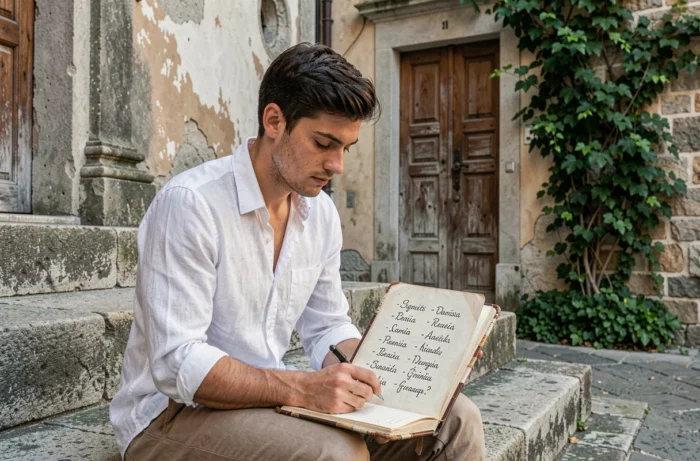
The 2026 trends show a rebound of names like Marco and Luca, two forms directly linked to the evangelists. Popular articles present them as mere “classic Italian names” without recalling their explicit biblical roots. Marco refers to the evangelist Mark, Luca to the evangelist Luke.
- Matteo (gift of God) – Italian form of Matthew, stable at the top of Italian rankings for several years
- Gabriele (God is my strength) – name of the archangel Gabriel, very common in Italy including in its feminine form Gabriella
- Davide (beloved) – Italian version of David, the biblical king, regularly used in all regions
- Samuele (God has heard) – Italian form of Samuel, constantly on the rise
- Giovanni (God is gracious) – one of the oldest names recorded in Italian parish registers
These names are not interchangeable. Giovanni carries a more traditional connotation, sometimes associated with previous generations, while Samuele is perceived as more modern despite its identical biblical antiquity.
Italian Female Biblical Names and Their Symbolic Register
The Italian female biblical repertoire is more limited but distinctive. Sara, Anna, Rebecca, and Rachele form the core of Italianized biblical female names. Their uniqueness: the Italian form is often very close to the French form, making them easy to bear in a bilingual context.
Some less expected names deserve attention. Noemi (my sweetness, in Hebrew) has gained popularity in Italy in recent years, driven by a sound that matches the current taste for names ending in -i. Abigail, in its Italian form Abigaille, remains rare but exists in the civil registry.
Elisabetta (God is my oath) offers an alternative to the very French Élisabeth, with a distinctly Italian musicality thanks to the double T and the suffix -etta. Marta, a direct Italian form of Marthe, the sister of Lazarus, has the advantage of being short, international, and immediately understood.
Rare Italian Biblical Names and Civil Registry Constraints
The Italian civil code regulates the choice of names. A name must not harm the child or create confusion about gender. This constraint leads some parents to favor clearly gendered forms, which explains the rarity of certain ambiguous biblical names in Italian.
Among the rare but valid forms:
- Elia (my God is Yahweh) – Italian form of Elijah, exclusively masculine in Italy while it may be perceived as feminine in France
- Giosuè (God saves) – Italian equivalent of Joshua, with a distinctive grave accent
- Tobia (God is good) – Italian form of Tobiah, derived from the book of Tobit, uncommon but attested
- Isacco (he will laugh) – Italian version of Isaac, recognizable but rarely assigned today

The case of Andrea illustrates a subtlety often overlooked. In Italy, Andrea is exclusively a masculine name, derived from the Greek andreios (manly). French parents who associate it with the feminine make a cultural misunderstanding. Although it is not strictly biblical, its massive use in the Italian Christian tradition (Saint Andrew, apostle) justifies its mention here.
Criteria for Choosing an Italian Biblical Name in France
The phonetic compatibility between Italian and French is the most pragmatic filter. Names ending in -eo (Matteo, Timoteo) or -ele (Gabriele, Samuele, Raffaele) transition well orally in France without major distortion.
Names ending in -ppe (Giuseppe, Filippo) pose more problems. The double P in Italian is systematically simplified orally in French, altering the original sound. Giuseppe often becomes “Jousèpe,” very far from the Italian pronunciation.
We observe that bilingual families favor forms that work in both languages without adaptation: Luca, Sara, Anna, Davide. This pragmatic choice does not detract from the spiritual dimension. The symbolic weight lies in the Hebrew etymology, not in the complexity of the name.
The simplest Italian biblical name to bear in France remains the one whose pronunciation requires no explanation. This is a criterion that weighs daily much more than apparent originality.