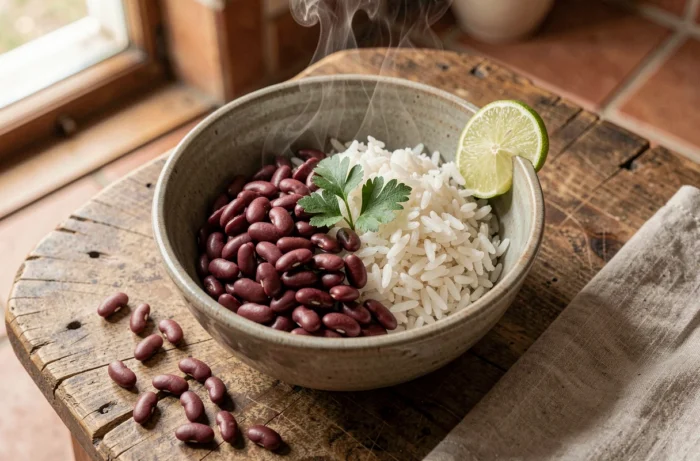
The rice and red bean duo forms the daily diet of hundreds of millions of people, from Latin America to the Caribbean and across West Africa. Measuring the benefits and limitations of this combination involves examining two nutritional profiles that complement each other on paper, but whose daily repetition raises specific questions: amino acid balance, glycemic load, exposure to certain contaminants.
Comparative nutritional profile of white rice and red beans
Before evaluating the relevance of daily consumption, we must present the raw data. The table below compares the two foods for a standard cooked portion.
| Criterion | Cooked white rice (common portion) | Cooked red beans (common portion) |
|---|---|---|
| Protein | Low, deficient in lysine | High for a legume, deficient in methionine |
| Fiber | Very low | High (soluble and insoluble fibers) |
| Glycemic index | Medium to high depending on the variety | Low |
| Iron and minerals | Modest intake | Good source of non-heme iron, potassium, magnesium |
| Antinutrients | Negligible after cooking | Lectins destroyed by prolonged boiling, phytates partially reduced by soaking |
| Contaminant risk | Inorganic arsenic (variable depending on origin and variety) | Negligible |
The association works on the principle of amino acid complementarity: the lysine in red beans compensates for the deficiency in rice, and the methionine in rice complements that of the beans. Together, they form a more complete protein profile than a meal based on either one alone.
Red beans also lower the glycemic impact. Their richness in fiber and resistant starch slows the absorption of carbohydrates from rice, which mitigates the postprandial blood sugar spike. To delve into the benefits of red beans according to 10 Grammes, this nutritional complementarity is a central point.

Arsenic in rice: a factor amplified by daily frequency
Rice absorbs inorganic arsenic present in soil and irrigation water more effectively than most other grains. This is not a one-time issue, but it takes on a different dimension when consumption becomes daily.
EU Regulation 2023/915 sets distinct regulatory limits depending on the type of rice, with stricter limits for foods intended for infants and young children. The question is therefore not “Is rice dangerous?” but rather: which variety, how often, for which audience.
Brown rice vs. white rice: a nutritional paradox
Brown rice is often presented as the healthy choice due to its fiber and micronutrients retained in the bran. However, arsenic concentrates in the outer layers of the grain. White rice, stripped of these layers by polishing, generally shows lower levels of arsenic.
This paradox complicates nutritional advice. Choosing whole rice for its fiber also means accepting a higher exposure to arsenic. Alternating between the two types of rice, or varying starches, becomes a more reasonable strategy than a binary choice.
Reducing exposure without eliminating rice
Several preparation practices limit the arsenic content of cooked rice:
- Rinsing the rice thoroughly before cooking, then cooking it in a large volume of water (a ratio of at least 6 to 1) and discarding the excess water significantly reduces arsenic concentration
- Varying the geographical origin of the rice, as arsenic levels fluctuate depending on the soils and agricultural practices of each producing region
- Alternating rice with other starches (quinoa, whole pasta, potatoes, sweet potatoes) to reduce the frequency of weekly exposure
Health authorities and specialized publications converge on a simple principle: diversification of starches is the best protection against overexposure to a single contaminant.
Daily legumes and metabolic health: what recent data shows
On the side of red beans, the assessment of regular consumption is significantly more favorable. Legumes in general, and red beans in particular, are associated with positive effects on several health markers.
Recent meta-analyses indicate that regular consumption of legumes helps lower total cholesterol and LDL cholesterol. The soluble fibers in red beans play a direct role in this mechanism by trapping bile acids in the intestine.
In terms of blood sugar, legumes are among the foods with the lowest glycemic index. Their content of resistant starch nourishes the gut microbiota and promotes the production of short-chain fatty acids, which are beneficial for the colonic mucosa.
The digestive issue: a frequently overestimated barrier
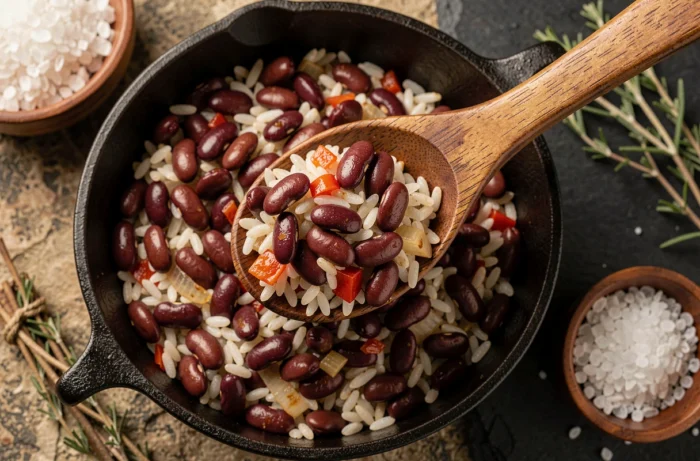
Flatulence related to red beans is real but manageable. Prolonged soaking (at least eight hours), rinsing, and boiling reduce the oligosaccharides responsible for gas. Gradual adaptation of the gut microbiota does the rest: after a few weeks of regular consumption, digestive comfort improves for most people.
A more serious point concerns lectins, particularly phytohemagglutinin present in raw red beans. Insufficient cooking of red beans can cause acute gastrointestinal disturbances. The rule is simple: soak, then boil vigorously for at least ten minutes. Canned beans, already cooked industrially, do not pose this problem.
Appropriate frequency: daily, biweekly, or rotation
Eating rice and red beans every day is not dangerous in itself, but it is not the most prudent strategy in the long term. The nutritional benefit of the combination is real. The risk comes from monotony.
French nutritional guidelines recommend consuming legumes at least twice a week. This frequency is a minimum, not a ceiling. Increasing to three or four times a week poses no identified problems, provided that the types of legumes are varied (lentils, chickpeas, white beans).
For rice, caution suggests not making it the exclusive starch. A rotation throughout the week, incorporating other sources of complex carbohydrates, dilutes exposure to arsenic without sacrificing energy intake.
- Two to three rice-red bean meals per week cover protein complementarity without overexposing to rice arsenic
- On remaining days, replace rice with bulgur, whole pasta, or quinoa while keeping legumes
- Alternate red beans with lentils, chickpeas, or white beans to diversify micronutrient intake
The rice-red bean duo remains one of the most effective combinations in terms of cost/nutritional quality ratio. The only solid reservation concerns the daily repetition of rice, for which diversification remains the best lever to limit cumulative exposure to arsenic. Red beans, on the other hand, deserve a regular place on the plate without any particular restrictions for a healthy adult.