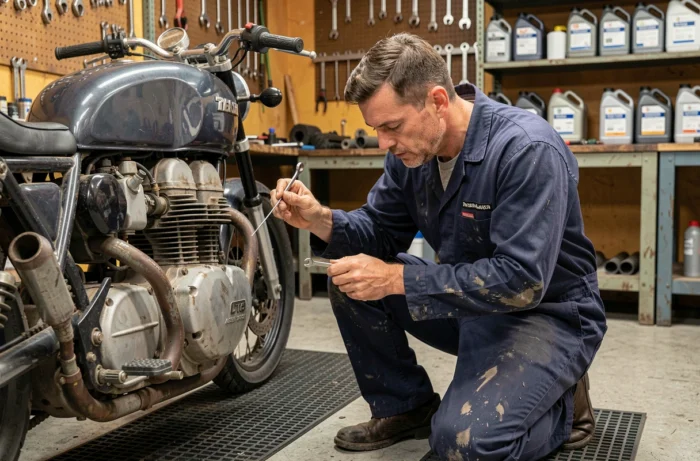
A well-tuned 4-stroke trial bike does not lose power overnight. The degradation is gradual, often masked by the rider’s habits, until the day the engine struggles on a technical climb or fails to maintain idle in the zone. A clogged air filter, oil degraded by the thermal stresses of trial, and valve clearances that drift: each neglected parameter takes away a bit of engine response.
Additionally, since 2024, there has been a tightening of noise controls that makes exhaust compliance as strategic as pure mechanics.
Air filter in 4-stroke trial: the component that conditions everything else
General maintenance guides recommend cleaning the filter every few thousand kilometers. In trial, this logic does not hold. The bike operates at low speed, engine under load, in dust, sand, or mud. The air drawn in is significantly more loaded with particles than during road riding.
A recent technical guide (CarParts, 2026) recommends to clean, dry, and re-oil the filter after each outing in dusty conditions. This is not an excess of caution. A clogged filter weakens the air-fuel mixture, which first results in a gradual loss of power, and then, if the situation persists, leads to accelerated wear of the engine’s internal components.
The procedure takes about ten minutes: remove the foam filter, wash it with a mild degreaser, let it dry completely, then apply a specific filter oil evenly. Reinstalling a filter that is still damp with solvent is counterproductive, as the solvent dissolves the filtration oil and allows fine particles to pass through. This is a step that is part of the maintenance for trial bikes that offers the best effort-to-benefit ratio.

Engine oil and valve clearance: two linked parameters on a 4-stroke trial
On a 4-stroke engine used in trial, the oil operates under atypical conditions. The RPMs are moderate, but the mechanical loads are high: continuously engaged clutch, sudden accelerations in short gears, and engine temperature rising quickly at low speed due to lack of natural ventilation.
The oil degrades faster than in road use despite low mileage. Relying on the odometer to schedule oil changes is a common mistake. The frequency should be based on operating hours or the number of outings, not on distance traveled. Replacing the oil filter with each oil change remains the rule for these engines.
Valve clearance and engine response
Checking the valve clearance is often postponed because it requires partial disassembly. On a 4-stroke trial bike, this clearance drifts with operating hours. A clearance that is too tight prevents the valve from closing completely, leading to compression losses, difficult starting, and a decrease in torque at low RPMs, where trial demands the most precision.
Out-of-tolerance valve clearance first manifests as an unstable idle, then as an engine that “grabs” less when exiting a turn. Field reports vary on the ideal frequency for checking, as it depends on the model and intensity of use. The manufacturer’s manual remains the reference, but a systematic check at the end of each season is a reasonable minimum.
Sound compliance and exhaust: what has changed since 2024
The tightening of noise controls on motorized two-wheelers does not only concern the road. Event organizers and practice areas are applying increasingly strict noise thresholds, and 4-stroke trial bikes are not exempt despite their low-speed operation.
An original exhaust with a worn or perforated silencer can exceed the allowed limits. The absorbent materials inside the muffler degrade over time and heat, gradually altering the bike’s acoustic signature. Replacing the rock wool or fiber in the silencer is a preventive operation that is often overlooked.
- Visually check the condition of the collector and silencer (cracks, corrosion points, loose fittings) before each season.
- Check the sealing of the joints between the collector and the cylinder head, as a leak at this level increases noise and distorts the air-fuel mixture.
- Replace the absorbent material in the silencer as soon as the perceived noise level increases significantly, without waiting for an official check.
An non-compliant exhaust can lead to exclusion in competition or a citation during on-site checks. The available data does not allow for a universal decibel threshold, as regulations vary by federation and country. Checking the rules applicable to one’s practice area remains the most reliable precaution.
Transmission and chassis: the overlooked check points in trial
The chain of a trial bike wears according to a different pattern than that of a trail or road bike. Clutch jolts, obstacle crossings, and dirt projections concentrate wear on specific links. Irregular tension or insufficient lubrication accelerates the deterioration of the entire kit (chain, sprocket, crown).
- Clean the chain after each muddy outing with an appropriate product, then lubricate it once dry.
- Check the tension according to the manufacturer’s specifications, also verifying the alignment of the rear wheel.
- Inspect the torque of the spokes, wheel by wheel, turning by quarters to avoid warping the rim.
- Check the condition of the steering and swingarm bearings, which endure significant lateral stresses in trial.
The torque of the spokes loosens faster in trial than in road riding due to repeated shocks. A broken spoke in the zone can permanently warp the rim. The auditory check (tapping each spoke with a metal tool to identify those that sound “hollow”) remains a simple and effective method before each outing.
Maintaining a 4-stroke trial bike relies on simple actions but applied at a higher frequency than what road-use manuals suggest. The air filter after each dusty outing, oil based on engine hours, valve clearance checked at the end of the season, and exhaust inspected to stay within noise limits: these four areas cover the vast majority of performance losses observed in the field.