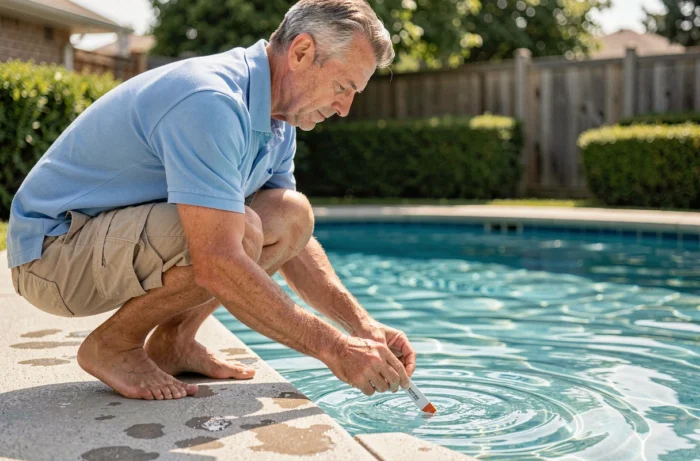
Even if you maintain a correct chlorine level, the water turns cloudy after a few days of sunshine. The problem often comes from CYA, cyanuric acid, this stabilizer that protects chlorine from UV rays but, if mismeasured, blocks the entire disinfection chain. Managing the CYA level in a pool is about finding the balance between sun protection and the actual effectiveness of the treatment.
Free chlorine and CYA ratio: the true disinfection indicator
Most guides focus on the CYA range in ppm. You measure, compare to the chart, and adjust. The problem is that a normal CYA level does not guarantee healthy water if the free chlorine is not calibrated accordingly.
A pool with a high CYA can show chlorine at 3 ppm on the test strip and give the impression that everything is fine. In reality, the active chlorine available for disinfection is very low when the CYA rises. The chlorine molecule remains bound to the stabilizer and does not release quickly enough to neutralize bacteria and algae.
In practice, you adjust the target free chlorine level to the measured CYA level. The higher the stabilizer, the more you need to increase the chlorine. It’s a ratio, not two independent values. If you want to delve deeper into the CYA level in pools on Be At Home, this chlorine-stabilizer binding mechanism is detailed there.
During heatwaves and periods of heavy use, this adjustment becomes critical. Heat accelerates the consumption of free chlorine, and a CYA that is too high prevents the disinfectant from meeting the demand. You then end up overdosing chlorine to compensate, which generates more disinfection by-products (chloramines, trihalomethanes). Managing CYA also means limiting exposure to these irritating compounds.
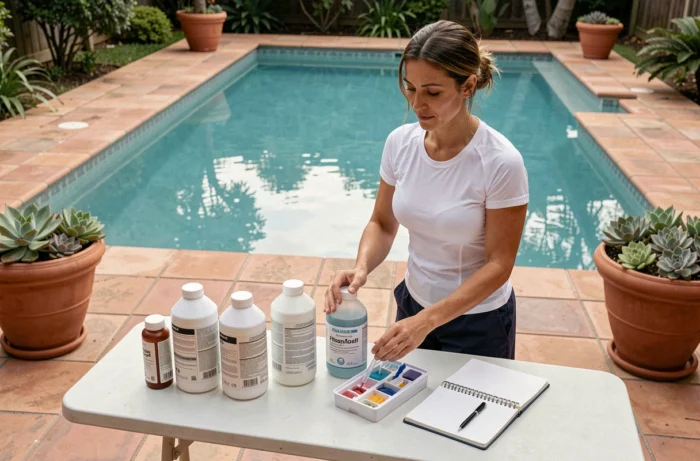
CYA too high in pools: escaping the trap of stabilized tablets
The classic scenario: you have been using stabilized chlorine tablets (dichlor or trichlor) since the pool opened. Each tablet adds a dose of CYA that does not evaporate, does not degrade, and accumulates week after week. By mid-season, the stabilizer reaches levels where chlorine becomes almost ineffective.
Cyanuric acid does not naturally break down in water. Neither the sun, nor filtration, nor pH correcting products lower it. The only reliable method to reduce excess CYA remains partial drainage.
Partial drainage: the concrete steps to follow
Drain between a quarter and a third of the pool volume, then refill with fresh water. Wait for complete recirculation (filtration running for several hours) before retesting the CYA. If the level remains too high, repeat the process.
- Turn off the heating and automatic treatment before draining to avoid any pump or cell malfunction
- Never completely drain an inground pool without checking the groundwater pressure; the risk of uplift is real in certain clay soils
- Retest the CYA at least 24 hours after refilling, as the dissolution of residual stabilizer takes time
Chemical CYA reducers exist, but feedback on this point varies. Some pool professionals report satisfactory results, while others find limited or temporary effectiveness. Dilution remains the safe bet.
Switching to unstabilized chlorine: when and how
The logic is simple: if CYA rises on its own due to the tablets, stop adding more. Switch to unstabilized chlorine (calcium hypochlorite, bleach, or salt electrolysis) and manage the stabilizer separately, adding pure cyanuric acid only when the level drops below the low threshold.
This approach requires a bit more rigor at the start. Unstabilized chlorine degrades faster under UV light, necessitating more frequent additions or an automated system. In return, you maintain total control over the CYA.
Quality of pure stabilizer: a detail that matters
Not all stabilizing products sold in garden centers are equal. The purity of cyanuric acid varies by manufacturer, and impurities can skew measurements or disrupt water balance. Choosing a stabilizer of recognized technical quality avoids unpleasant surprises, especially when dosing to the gram for a small pool.
Measuring CYA levels in pools: reliability of tests
The turbidity test (melamine reactive) remains the most common for home use. You pour a water sample into a graduated tube, add the reagent, and observe at what level the black dot at the bottom disappears. Simple, but imprecise beyond 100 ppm.
- Multi-parameter test strips sometimes include a CYA indicator, but their accuracy on this parameter is low compared to pH or chlorine
- Electronic photometers provide a more reliable reading, provided the calibration procedure is followed
- Having a sample analyzed at a specialized store once or twice a season allows you to recalibrate your own measurements
You should measure CYA at least once a month during the season, and systematically after a significant water addition (heavy rains, partial drainage, refilling). A monthly test is sufficient when using unstabilized chlorine, as CYA does not change on its own anymore.
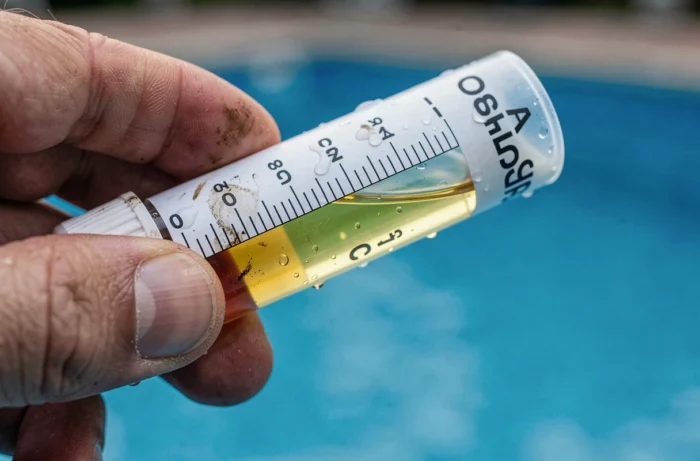
The ideal CYA level is between 30 and 50 ppm for a pool treated with conventional chlorine, and between 60 and 80 ppm for a saltwater pool. Beyond 100 ppm, even a high free chlorine level loses its disinfecting power.
The real management of the stabilizer is not about aiming for a fixed number, but about continuously adjusting the CYA-chlorine pair according to temperature, usage, and type of treatment. A pool where the stabilizer is controlled consumes fewer products, irritates the skin less, and keeps clear water without excessive effort.