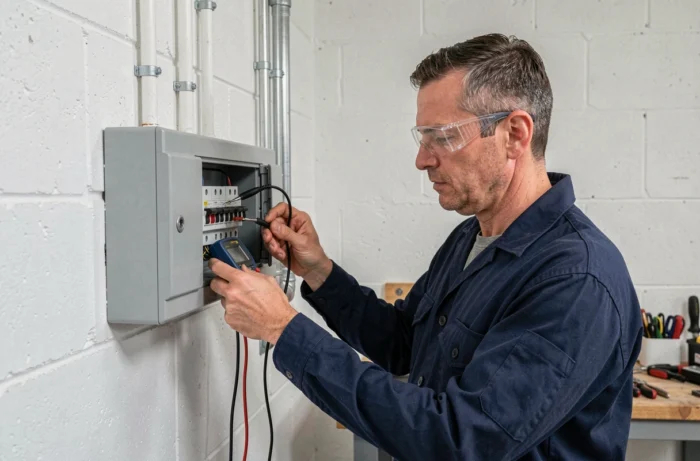
A socket that no longer holds on the wall, a circuit breaker that trips for no apparent reason, a project for a charging station for your electric car: the opportunities to call an electrician are frequent. Understanding the main categories of electrical services allows for better communication with a professional and helps avoid unpleasant surprises on the estimate.
New NF C 15-100 series: what changes for home interventions
You may have heard of the NF C 15-100 standard. It is the reference text that sets the rules for all low voltage electrical installations in France. Until recently, it was a single document, often perceived as a monolithic block.
Since August 23, 2024, this standard has been split into a series of 21 specific standards (NF C 15-100-X). Each part covers a specific area: residential buildings, electrical panels, communication networks, electric vehicle charging stations. A coexistence period with the old version runs until August 23, 2025, after which the Consuel will apply the new series starting September 2025 for renovations and April 2026 for new constructions.
Any electrician working in your home on an installation created or modified after these dates must reason in multiple parts of the standard, rather than a single reference. If you are having your electrical panel redone or adding a dedicated circuit, ask your provider if they are already working according to the 2024 series.
This is a good indicator of their professional update. To learn more about Electriciret, a player who structures its services around these normative developments, the approach becomes clearer.
Electrical panel and compliance: the foundation of any service
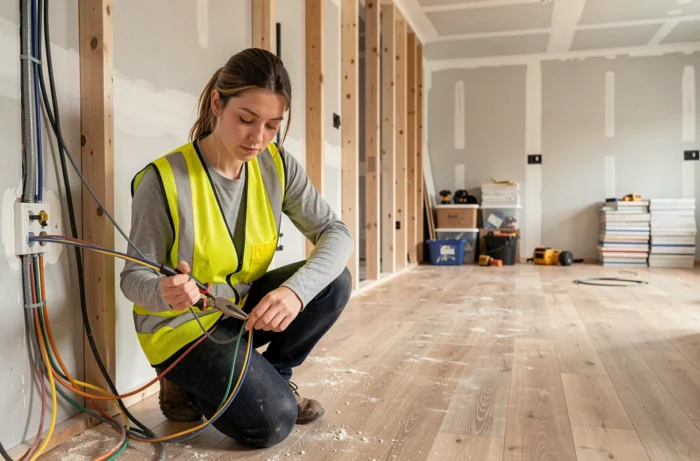
The electrical panel is the nerve center of your installation. It distributes power to each circuit (lighting, sockets, heating, cooking) and houses the protection devices: circuit breakers, residual current devices, surge protectors.
When should you intervene on a panel?
Several situations require compliance or replacement:
- A move into an old home where the panel still has plug fuses, a sign of an outdated installation that no longer meets current requirements.
- The addition of a dedicated circuit, for example for a cooktop, a dryer, or a charging station, which requires an appropriately sized circuit breaker and differential protection.
- An electrical diagnosis (mandatory for sale or rental for homes over fifteen years old) that reveals anomalies in the distribution or protection of circuits.
A compliant panel protects people and property. A residual current device detects current leaks in a few milliseconds and cuts off power before any risk of electrocution. Without this device, or with an outdated model, protection is no longer guaranteed.
Surge protector: an increasing obligation
The new normative series extends the obligation to install a surge protector in the electrical panel to more French departments. This small module absorbs surges caused by lightning and protects your sensitive equipment (internet box, appliances, home automation). Check if your department is on the list of affected areas before approving a compliance estimate.
Electrical troubleshooting: distinguishing urgency from planned renovation
Not all electrical problems are the same. A socket that crackles or a circuit breaker that repeatedly trips may indicate an insulation fault, circuit overload, or a defective appliance. Electrical troubleshooting involves identifying the exact cause before repairing.
An electrician begins by measuring the insulation of the circuits using a megohmmeter, then tests each output from the panel. This method allows for locating the faulty circuit without dismantling the entire installation. The cost and duration of the intervention depend directly on the complexity of the fault.
In contrast, a planned renovation (complete rewiring, installation of ICTA conduits, redistribution of circuits) involves a structured project over several days. Confusing the two types of service often leads to incomprehensible estimates or incomplete work.
Home charging station: a dedicated circuit
Installing a charging station for an electric vehicle is not just about putting a reinforced socket in the garage. The station requires a dedicated circuit from the electrical panel, with a properly sized circuit breaker and differential protection of type A or F depending on the model of the station.
The NF C 15-100-7-722 series specifically regulates this type of installation. It notably requires a cable size suitable for the charging power and an accessible cut-off device. A qualified IRVE electrician (Infrastructure for Charging Electric Vehicles) is required for stations exceeding a certain power, and this qualification conditions access to certain public aids.
Before choosing your station, have the available power on your meter checked. An undersized meter requires requesting a power change from your supplier, which can extend the project by several weeks.
Sockets, switches, and lighting: common interventions
The addition or relocation of sockets and switches remains the most requested service. The standard imposes a minimum number of sockets per room (varies according to the area and purpose of the room). A bedroom, living room, and kitchen do not have the same requirements.
For lighting, the choice between a ceiling light, recessed spots, or wall sconces depends on both the use of the room and the existing cable routing. Each light point must have its own control circuit, connected to a switch or dimmer.
These tasks may seem simple, but a poor connection (forgotten ground wire, insufficient size, poorly closed junction box) creates real risks. Even for a single socket, compliance with the standard is not optional.
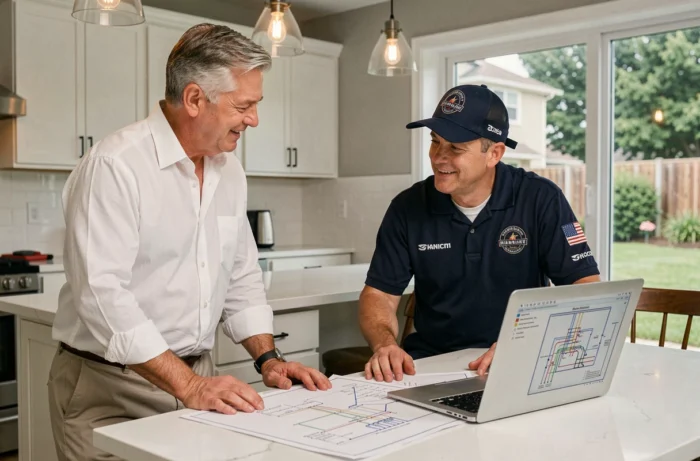
The choice of a provider for your electrical work is based on three concrete criteria: their knowledge of the current normative series, their ability to correctly size the protections, and the clarity of their estimate. A detailed estimate, line by line, remains the best tool for comparing offers and avoiding unexpected additions during the project.