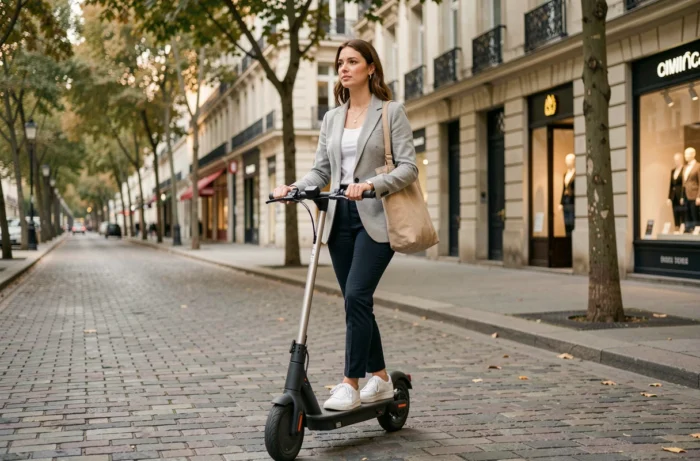
Electric scooter or urban bike: the choice is not just about handlebar preference. Behind these two modes of transport lie different legal statuses, distinct insurance obligations, and usage costs that most online comparisons do not address. Here are the factual elements to decide between these two mobility options in the city.
Legal status of electric scooters and bikes: two distinct categories
Electric scooters are classified as motorized personal transportation devices (EDPM). This category imposes a maximum speed limit of 25 km/h, prohibits riding on sidewalks (unless municipal regulations allow it), and has specific traffic rules for roadways or bike lanes.
The electric-assist bicycle (EAB), on the other hand, remains legally equivalent to a traditional bike as long as its motor does not exceed 250 W and assistance cuts off beyond 25 km/h. This distinction has direct consequences on the required equipment, authorized paths, and penalties incurred.
Civil liability insurance is mandatory for an electric scooter operating on public roads. A compliant EAB, however, does not require a specific insurance contract beyond standard civil liability (often included in home insurance). The annual cost of EDPM insurance varies depending on the contracts, but it is a budget item to consider from the moment of purchase.
To compare the models available on the market and refine your criteria, 1001 Roues offers a wide catalog of scooters and urban bikes.
Local regulations in 2026: helmet, vest, and new obligations
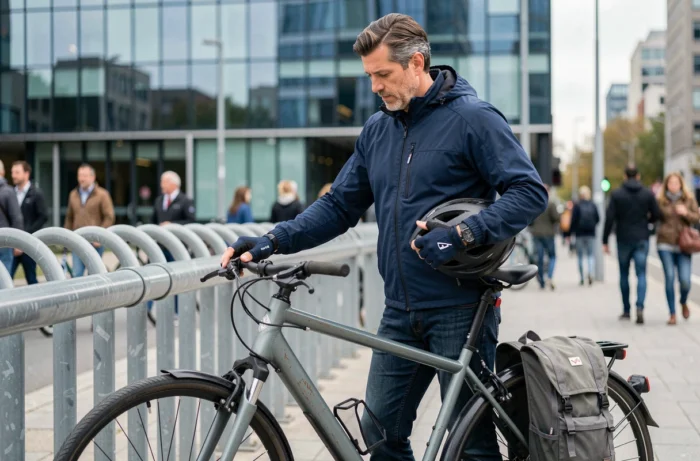
Since 2025, several municipalities have strengthened obligations for electric scooter users, particularly regarding wearing helmets and reflective vests.
For cyclists, the framework remains different. Helmets are only mandatory for children under 12 across the entire territory. The government is considering a generalization of helmet use for bicycles and electric scooters, but no national legislation has been adopted to date. Feedback from the field varies on the effectiveness of these local measures, with some cities noting a decrease in the use of self-service scooters after their implementation.
What this changes for vehicle choice
If you are traveling in a city that has adopted these strengthened obligations, the electric scooter requires more cumbersome equipment on a daily basis. The helmet and reflective vest add to the weight and bulk of the device during multimodal trips (metro, bus, office).
The urban bike, in this context, offers a lighter regulatory burden. Its older and more stable legal framework also exposes users to fewer surprises in case of a check.
Purchase budget and end of national subsidies for electric bikes
Comparisons focus on the purchase price, but a major change occurred at the beginning of 2025. The ecological bike bonus and the conversion premium ended on February 14, 2025, in accordance with decree n° 2024-1084 of November 29, 2024. Buying an EAB in 2026 will therefore be without national aid, which significantly alters the budget calculation.
Some local authorities maintain their own aid schemes, but the amounts and conditions vary greatly from one area to another. Check with your town hall or metropolitan authority before counting on financial assistance.
For electric scooters, no national premium has ever been established. The entry cost is generally lower than that of an EAB, but you must add the mandatory EDPM insurance, the replacement of the battery in the medium term, and, depending on the municipality, the purchase of an approved helmet and vest.
Costs to anticipate over two years
- For an EAB: purchase price (without national aid), standard mechanical maintenance (brakes, tires, chain), possible battery replacement after several years of intensive use
- For an electric scooter: purchase price, civil liability insurance EDPM, tire wear (faster on small wheels), battery replacement, mandatory safety equipment depending on the municipality
- In both cases: quality lock, occasional repairs, visibility accessories (lighting, reflectors)
Urban terrain and driving comfort: what wheel size changes
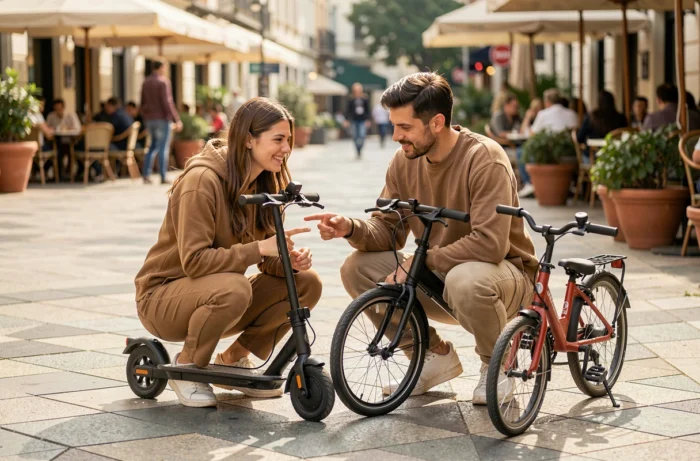
The diameter of the wheels is an underestimated technical factor. Electric scooters use small-diameter wheels, making them sensitive to potholes, tram tracks, and degraded surfaces. In the city, these obstacles are common and increase the risk of falling.
An urban bike, with wider wheels and a suspension (even basic on a city bike), absorbs road irregularities better. The seated position also reduces fatigue on trips exceeding a few kilometers. For a daily trip longer than five kilometers, the difference in comfort becomes significant, especially in rainy weather when the grip of small wheels decreases.
Multimodality and public transport
The folding scooter fits under a desk or in the trunk of a train. This is its main advantage for trips combining multiple modes of transport. A folding bike offers the same flexibility but with greater weight and bulk.
A traditional non-folding bike raises the issue of secure parking. Without a bike storage area at work or at the train station, the risk of theft remains a real barrier to adopting urban cycling daily.
Choice criteria based on travel profile
- Short trip (less than five kilometers), flat terrain, frequent multimodality: the electric scooter remains relevant despite regulatory constraints
- Medium to long trip (five kilometers and more), elevation, carrying loads: the urban bike (electric or mechanical) offers more versatility and comfort
- Mixed use (leisure and commuting): the EAB allows covering both uses with a single vehicle, provided there is adequate storage space
The choice also depends on the local regulations in force in your municipality. Before purchasing, consult recent municipal orders: obligations vary from city to city and are evolving rapidly since 2025. A thoughtful purchase involves checking these constraints, not just comparing technical specifications.