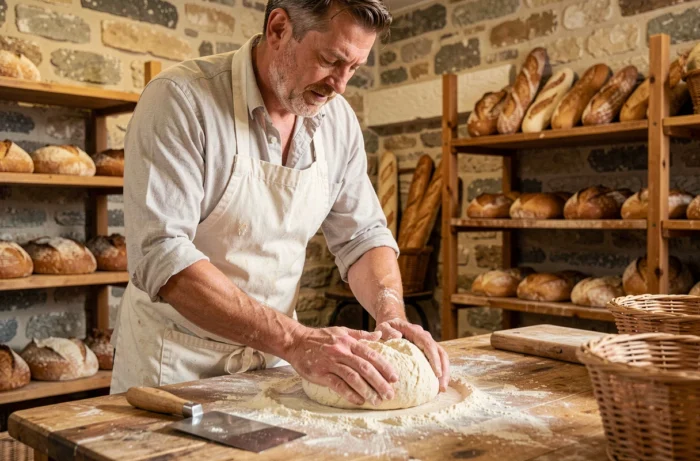
The artisanal bakery sector in France still represents about 11 billion euros in revenue. The number of bakeries has dropped from nearly 42,000 in 2003 to 29,600 today. Behind this decline lies a profound transformation of the artisanal baker’s profession, marked by rising fixed costs, competitive pressure from chains, and changing consumer expectations.
Energy costs and margins in artisanal bakeries: a structural pressure
The energy expense has long been a secondary cost for bakeries. This is no longer the case. According to data compiled by Panify from Cerfrance figures, the share of electricity has risen from about 5 to 7% of revenue to 8 to 12% in recent years. The oven, which runs several hours a day, accounts for most of this expense.
This increase is not temporary. It is part of a lasting trend that compresses margins. According to the same sources, the overall margin of artisanal bakeries-pastries has decreased from 69.5% to 66.1% of revenue between 2022-2023 and 2023-2024, while the share of energy rose from 4.2% to 5.0%.
For an artisan baker who makes their products on-site, this compression directly impacts their ability to invest in quality raw materials, renew equipment, or hire staff. The question is no longer just about making good bread, but finding an economic balance that allows them to continue doing so.
Establishments like La Maison De Daniel illustrate how some artisans maintain a strong commitment to the quality of their creations despite this tense context, focusing on a coherent range and a direct connection with their clientele.
Functional breads and natural sourdough: what customers are looking for in 2026
Artisanal bakeries that stand out today no longer rely solely on the word “tradition.” An industry overview published by Haxe Direct in 2026 highlights a shift: health and functional bread ranges are becoming a differentiation lever. Breads rich in fiber, incorporating specific seeds, formulated to meet precise nutritional expectations – these products are no longer niche.
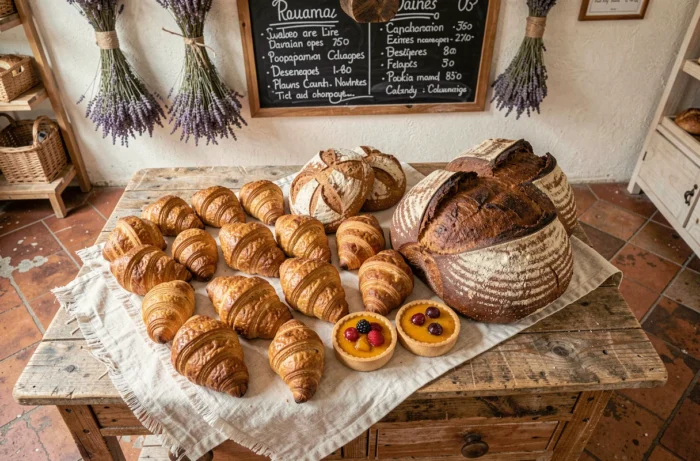
Natural sourdough, long confined to “organic” bakeries, is establishing itself as a quality marker perceived by a broader clientele. Its long fermentation time alters the texture, taste, and digestibility of the bread. For the baker, it is also a technical choice that requires skill and time, two resources that industrial production compresses.
What distinguishes a handcrafted sourdough bread
- A fermentation period of several hours (sometimes more than 12 hours), which develops complex flavors and improves shelf life without additives
- The use of selected flours, often from local millers, with ancient varieties like khorasan or spelt
- Manual shaping that gives each loaf a slightly different shape and crust, far from industrial uniformity
This positioning around product quality and flavors allows some artisanal bakeries to justify a higher price to customers seeking something other than a standardized baguette.
Artisanal bakery vs. chains and franchises: where the difference lies
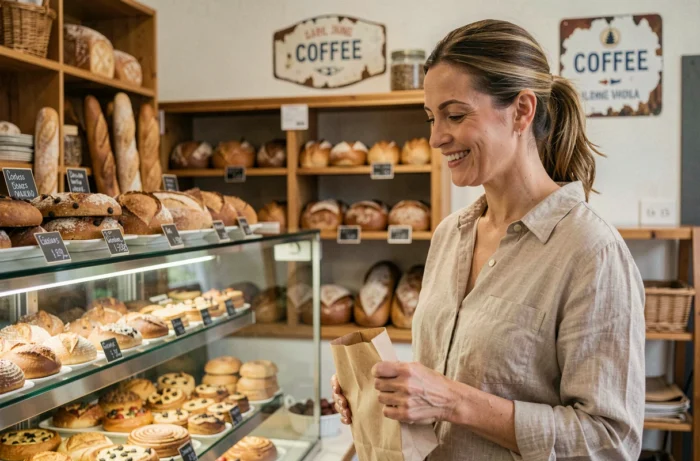
The competition does not only come from cooking terminals in supermarkets. Bakery chains have multiplied and significantly upgraded their offerings in recent years. Careful displays, “homemade” recipes, communication about ingredients: the visual boundary between artisan baker and franchised brand has blurred.
In France, about 60% of the remaining bakeries are located in urban areas with more than 50,000 inhabitants, where competitive density is highest. The most vulnerable artisans are found in rural areas or medium-sized towns, where the customer volume does not always suffice to absorb rising costs.
What the artisan masters that the chain cannot replicate
The difference rarely lies in the appearance of the finished product. It is upstream: the choice of flours, the management of fermentation time, the daily adaptation of the recipe based on temperature and humidity. An artisanal baker adjusts their work every morning. A chain applies a standardized protocol.
This adaptability is also reflected in the pastry and viennoiserie offerings. While a franchise offers a fixed catalog renewed by headquarters, an artisan can test a creation, modify it based on customer feedback, and remove it if it does not work. The agility of the small structure remains a real advantage, provided the economic model holds.
Transparency about ingredient origins: a growing consumer expectation
Recent regulatory developments regarding the origin and quality of food products are pushing the entire sector towards greater traceability. Artisanal bakeries, because they often work with a limited number of suppliers, are better positioned than others to meet this demand.
- Displaying the name of the miller and the origin of the flour helps create a trust bond with the local clientele
- Offering products made from certified organic flours meets a documented expectation but involves significant sourcing costs
- Communicating about manufacturing methods (slow kneading, absence of improvers, baking on stone) differentiates the artisan in a verifiable way
Transparency is becoming a concrete selling point, not just a marketing pitch. Customers who enter an artisanal bakery rather than buying in a supermarket make an active choice. Empowering them to understand what they are purchasing strengthens loyalty.
The artisanal bakery sector is undergoing a period of restructuring. Artisans who combine technical mastery, tight cost management, and transparent communication about their products maintain a place that neither chains nor industry can occupy. Quality artisanal bread remains a sought-after product, provided that those who make it can continue to make a living from it.