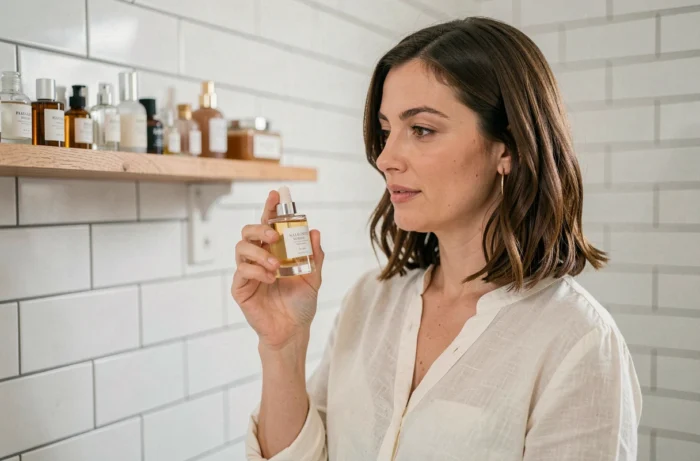
The concentration of fragrant raw materials in an Action dupe ranges between that of a light eau de toilette and a body spray. Understanding this parameter before making a purchase avoids disappointment regarding longevity and sillage. Here, we break down the technical criteria that separate a successful Action perfume dupe from a disappointing bottle, taking into account the new European regulatory constraints.
Concentration and formulation of Action perfume dupes: what the INCI list reveals
The house brands of Action (Figenzi, Capace, Floyesa) formulate their juices with a significantly lower percentage of fragrance concentrate than that of a branded eau de parfum. The vehicle is primarily composed of denatured alcohol and water, with an aromatic load that resembles that of a budget eau de toilette.
This choice of formulation explains two recurring phenomena. The first: the olfactory resemblance in the top note can be striking, as the most volatile molecules are often identical or very close to those used in the original perfume. The second: the base collapses after one to two hours because the expensive base materials (complex white musks, precious woods, high-purity ambroxan) are replaced by simpler synthetic alternatives.
We recommend reading the INCI list before purchase. A dupe that lists terms like “linalool,” “coumarin,” and “alpha-isomethyl ionone” shares at least the olfactory family of the targeted perfume. Conversely, a very short list (only three or four allergens) indicates a less complex juice. To spot the best Action perfume dupes on the shelf, this quick reading of the label saves time and money.
European Regulation 2023/1545 and allergen transparency on Action bottles
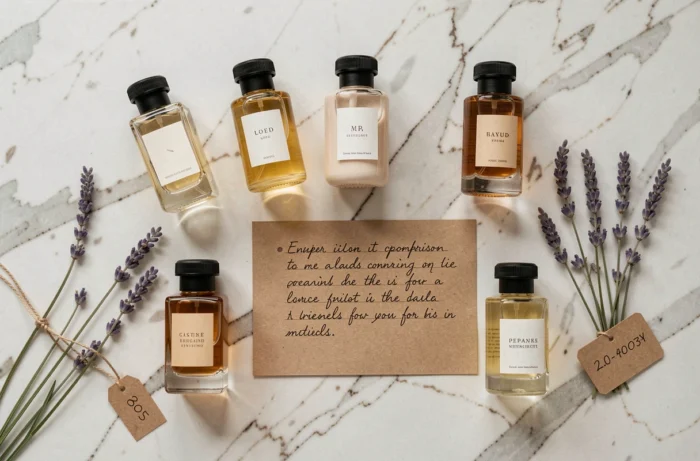
Since July 31, 2026, the Regulation (EU) 2023/1545 requires the individual naming of more than 80 fragrance allergens on the label of any new cosmetic launched on the European market. The generic mention “fragrance” or “aroma” is no longer sufficient to mask the composition.
The declaration thresholds remain set at 0.001% for a leave-on product like perfume. In practical terms, a Figenzi bottle launched after the summer of 2026 must list each odorant compound exceeding this threshold. This obligation now covers common synthetic molecules found in dupes (like lilial, lyral, or certain polycyclic musks) and frequent natural extracts (bergamot, rose, lavender).
For the informed consumer, this reform changes the game. Comparing the INCI list of the dupe and that of the original perfume becomes truly possible. A dupe that shares seven or eight allergens with its reference has a good chance of faithfully reproducing at least the top and heart notes. A marked discrepancy, on the other hand, indicates a free interpretation of the fragrance rather than a technical reproduction.
Olfactory notes and fragrance families: identifying the most faithful dupes
Not all Action dupes are created equal. We observe that the gourmand floral and woody oriental olfactory families are where the resemblance to the original perfume is most convincing. Fresh floral or citrus accords, on the other hand, lose their character more quickly due to the lack of stable citrus raw materials.
Some matches recognized by the community deserve attention:
- Amazing Life (Figenzi) compared to La Vie est Belle by Lancôme: very close iris-praline accord in the opening, coherent gourmand heart, base that lightens after about two hours.
- Marsela (Figenzi) compared to Coco Mademoiselle by Chanel: patchouli and rose present, but the base vetiver lacks depth compared to the original.
- Divinity (Figenzi) compared to Angel by Mugler: the chocolate-caramel note is identifiable, the oriental base remains linear where Angel offers a complex evolution.
- Gold Spender compared to One Million by Paco Rabanne: recognizable cinnamon leather, decent projection for a dupe at this price.
The common point of these successes: compositions where the signature molecule is accessible and inexpensive (ethyl maltol for the gourmand, linalool for the floral). When the original perfume relies on an expensive or patented ingredient, the dupe strays further away.
Longevity of Action perfume dupes: techniques to extend the sillage
The limited longevity of Action dupes is their main weakness. With a low concentration and economical fixatives, the sillage generally disappears after a few hours. Several techniques can help push this limit without changing products.
- Apply the dupe on hydrated skin (unscented balm or dry oil): aromatic molecules adhere better to an oily film than to dry skin.
- Spray on pulse points (wrists, neck, behind the ears) and on natural fiber clothing, which retains base notes longer than skin.
- Layer with a body lotion or mist from the same olfactory family to enhance the dominant accord without creating dissonance.
Reapplying in the middle of the day remains the most effective method. The compact format of Action bottles makes them easy to carry, which partially compensates for their modest longevity.
Choosing an Action dupe based on your reference fragrance
The most reliable approach is to identify the olfactory family and dominant notes of your favorite perfume, then look for the corresponding Action dupe in the same category. A fan of Sì by Giorgio Armani (fruity chypre) will turn to Selvacia rather than a gourmand floral, even if the latter is better rated on social media.
The price of Action dupes, generally below a few euros, allows for experimentation. We recommend buying two or three references close to your favorite scent and testing them on skin for a full day before making a decision. The result on skin varies significantly from person to person due to skin pH and sebum production.
The new labels enriched by Regulation 2023/1545 facilitate this selection by making the composition readable. A bottle whose allergen list largely overlaps with that of your reference perfume deserves to be tested first. This objective criterion usefully complements the subjective reviews found online.