The leisure time of the French is changing. Classic hobby lists circulate everywhere, but they mask a deeper evolution: the places, formats, and motivations that drive people to explore new pastimes have been transforming in recent years. Understanding these changes allows for more suitable choices based on real desires, rather than randomly picking from a catalog of activities.
Libraries and third places: underestimated leisure spaces
Media libraries are no longer limited to lending books. They now offer the loan of vinyl records, video games, musical instruments, and board games, in addition to creative workshops and conferences. This shift towards hybrid leisure spaces remains poorly documented in usual guides.
The figures confirm this trend. According to a barometer for the Ministry of Culture, 37% of the French visited a library or media library in 2024, up from 32% in 2019. Furthermore, 60% of them have made home lending free. Between 2023 and 2024, the number of entries in university libraries increased by 11%, and some large institutions are open more than 65 hours a week.
Specifically, a person looking for a new creative or cultural hobby can start by checking the program of their local media library. Bookbinding workshops, introduction to role-playing games, ukulele lending: the offerings vary by municipality, but the free or very low cost removes the financial barrier that often hinders experimentation. To discover leisure activities with Le Tour de la Question, this type of resource allows for comparing options before committing.

Outdoor physical activities: diversifying practice locations
The image of sports leisure confined to the gym or municipal field no longer corresponds to reality. A recent regional survey in Île-de-France shows that two-thirds of residents engage in physical activity at least one hour a week, with a wide variety of locations: forests, lakes, streets, city stadiums, in addition to traditional facilities.
This geographical dispersion opens doors to less visible disciplines. Nordic walking in peri-urban forests, canoeing on community water bodies, or street workouts on urban furniture do not require an annual subscription. They share a common point: the absence of rigid structure, which suits irregular schedules.
Field feedback varies on the sustainability of these solo practices. Without a collective framework, some people give up after a few weeks. Joining an informal group, even temporarily, seems to prolong commitment. Local sports associations often offer free discovery sessions, a format that allows for testing without pressure.
Creative hobbies and online platforms: beyond the tutorial
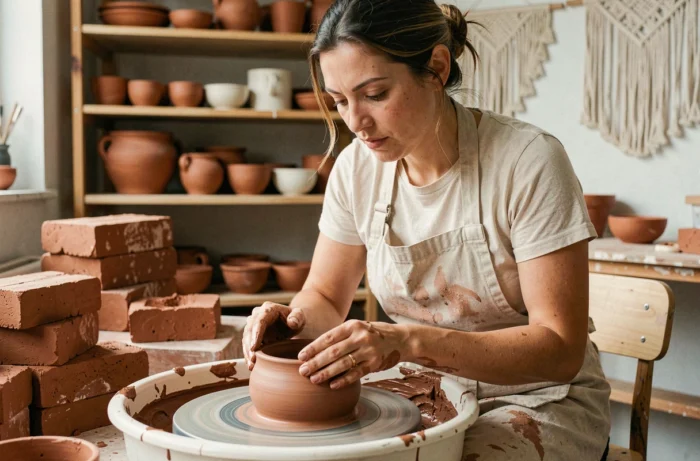
Digital platforms have multiplied access to creative workshops. Online pottery classes, embroidery tutorials on YouTube, short training sessions in digital illustration: the offerings are massive. The problem is no longer finding content, but choosing a format that leads to regular practice.
Several criteria help filter:
- The course format: a structured series in several modules generates more progress than an isolated tutorial, as it imposes a rhythm and intermediate steps
- The material or tool required: some activities (linocut, bookbinding, ceramics) require a moderate initial investment in materials, which constitutes a concrete commitment that encourages perseverance
- The possibility of showing a result: hobbies that produce a tangible object (a notebook, a print, a textile piece) maintain motivation better than those whose result remains immaterial
A creative hobby that produces a finished object maintains motivation longer. This observation appears in the testimonials of practitioners of diamond painting, artisanal bookbinding, or engraving. The finished object serves as a marker of progress.
The trap of digital fluttering
The abundance of online tutorials encourages a zapping behavior. One watches three calligraphy videos, two on macramé, one on Japanese lacquer, without ever going beyond the stage of passive curiosity. Choosing a single activity and sticking with it for four weeks yields clearer results than testing five disciplines in a month.

Collective leisure for adults: workshops, clubs, and hybrid formats
Solitary hobbies dominate online idea lists, but the social dimension remains a powerful lever. Collective workshops for adults are experiencing a resurgence of interest, driven by short formats: a single two-hour session instead of a quarterly registration.
Some concrete ideas that break the mold:
- Rotating cooking clubs, where each participant hosts the group in turn, with an imposed theme (cuisine from a country, unique ingredient, limited budget)
- Writing workshops in media libraries, often free, that combine literary constraints and collective reading
- Modern board game sessions in game libraries, an expanding sector that goes well beyond Monopoly
- Naturalist outings organized by local associations (ornithology, botany, astronomy), accessible without prior knowledge
The short and non-committal format facilitates the first step. The psychological barrier decreases when one knows that a single session is enough to assess their interest.
Leisure time and transferable skills: an often-overlooked angle
A hobby can also nurture skills usable in other contexts. Regular drawing practice improves spatial observation. Learning an instrument develops coordination and work discipline. The skills acquired in a hobby often spill over into professional life.
The available data do not allow for precise quantification of this effect, but feedback from practitioners points to a constant: people who invest time in a technically demanding hobby report a more lasting sense of accomplishment than those who prioritize purely recreational activities.
The choice of a new hobby benefits from integrating this dimension. Rather than seeking only entertainment, identifying a skill one wishes to develop (patience, manual precision, listening, storytelling) and then finding the activity that engages it provides a more motivating framework for exploration.
The range of leisure activities has never been so wide or so accessible. The real difficulty lies not in the lack of ideas, but in the ability to commit to a practice long enough to gain something from it. Four weeks on a single activity are worth more than a month of skimming through everything.