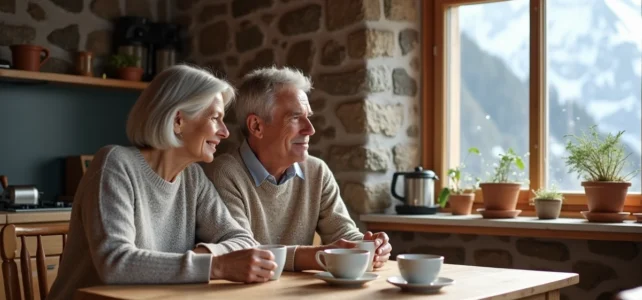
Jannik Sinner was born on August 16, 2001, in Innichen (San Candido), in South Tyrol, an Italian province bordering Austria where German and Italian coexist daily. His parents, Johann and Siglinde Sinner, met while both working in a mountain hut called Talschlüsshutte Hut. Their journey, rooted in alpine catering and rural life, shaped a family environment where discretion and autonomy take precedence over fame.
The alpine hut as a professional starting point
Johann Sinner worked as a cook, while Siglinde was a waitress, in this same ski hut nestled in the Dolomites. This is not a trivial detail: their shared profession in mountain catering structured their relationship with physical work, demanding hours, and a form of communal living typical of high-altitude huts.
The village of Sesto, where Jannik grew up, is a small alpine town. The mountainous environment explains why skiing, rather than tennis, was the first sport practiced by young Jannik. Before turning ten, he had already reached the level of national vice-champion in giant slalom for his age category.
To better understand the origin and journey of the Sinner parents, one must place their daily life in this alpine context where professional and family life blend, far from the media circuits of professional sports.
Transition from skiing to tennis: the concrete role of Johann and Siglinde
At thirteen, Jannik decided to give up skiing to focus on tennis. This shift required a significant parental choice: accepting that their son would leave the family home to train far from Sesto. Jannik himself publicly thanked his parents for this freedom of choice, stating after his victory at the 2024 Australian Open that he wished everyone could have parents like his.
Johann and Siglinde did not steer their son towards tennis. They simply accepted his decision, which, in an alpine environment where skiing represents a local path to success, was a real gamble. This non-interventionist stance contrasts with the highly directive parental models often observed in high-level sports.
Johann the cook on the professional circuit
A concrete extension of this support: Johann accompanied Jannik at certain ATP circuit events as his personal chef. This role allows him to maintain a daily connection without interfering in the sporting framework managed by the coaches. The father’s presence is not that of a manager or technical advisor, but that of a parent ensuring a specific logistical aspect.
Media discretion of the Sinner parents: an active choice
The Sinner family does not simply cultivate a low profile by temperament. Several elements show that this is a deliberate strategy:
- Siglinde does not systematically attend her son’s tournaments. Her presence at the Roland Garros final was described by Parents magazine as “not so common,” highlighting that her appearances are occasional and linked to symbolic moments.
- Johann and Siglinde have never given interviews in their own name to capitalize on Jannik’s fame. No advertising contracts, no appearances on entertainment shows.
- Jannik’s older brother, Mark, born in 1998, also remains withdrawn from the media sphere. Discretion is not the trait of a single family member, but a shared guiding principle.
This positioning contrasts with the visibility sought by other families on the circuit. The Sinner parents refuse to turn sporting success into family exposure.
Family values transmitted: work ethic and normality
Jannik Sinner has repeatedly mentioned the influence of his parents on his professional ethics. The link between physical work in a mountain hut and the rigor of tennis training is not coincidental. Johann and Siglinde raised their sons in an environment where daily labor was not an abstract concept, but a visible reality.
The player has also emphasized that his relationship with his parents has not changed despite fame. This relational stability is a marker of the Sinner family culture: the son’s fame does not alter the relationships, habits, or lifestyle of the parents who remain in Sesto.
Bilingualism as a cultural heritage
Growing up in South Tyrol implies a dual linguistic belonging. Jannik is fluent in German and Italian, along with English and some knowledge of other languages acquired on the circuit. This multilingual ease is directly inherited from the family and regional context. Johann and Siglinde evolved in an environment where switching from one language to another is part of daily life, without it being a specific educational project.
South Tyrol and German-Italian identity: a grounding that explains the player’s personality
South Tyrol is an autonomous province with special status, attached to Italy after World War I but predominantly German-speaking in culture. The inhabitants speak an Austro-Bavarian dialect at home and use Italian in administrative or professional interactions. This cultural duality produces a particular relationship with national identity.
Jannik Sinner represents Italy on the circuit, but his family background is culturally Austrian as much as it is Italian. This nuance sheds light on his personality, often described as reserved and methodical, traits more commonly associated with German-speaking alpine culture than with a Mediterranean temperament.
Johann and Siglinde embody this border identity without publicly claiming it. Their life in Sesto, a village of a few thousand inhabitants in the Dolomites, remains their main anchor, regardless of their son’s international travels. The choice to maintain this base of life, rather than moving to a city more connected to the world of tennis, confirms a constant in their decisions: preserving what existed before Jannik’s career.